Koonj 1650
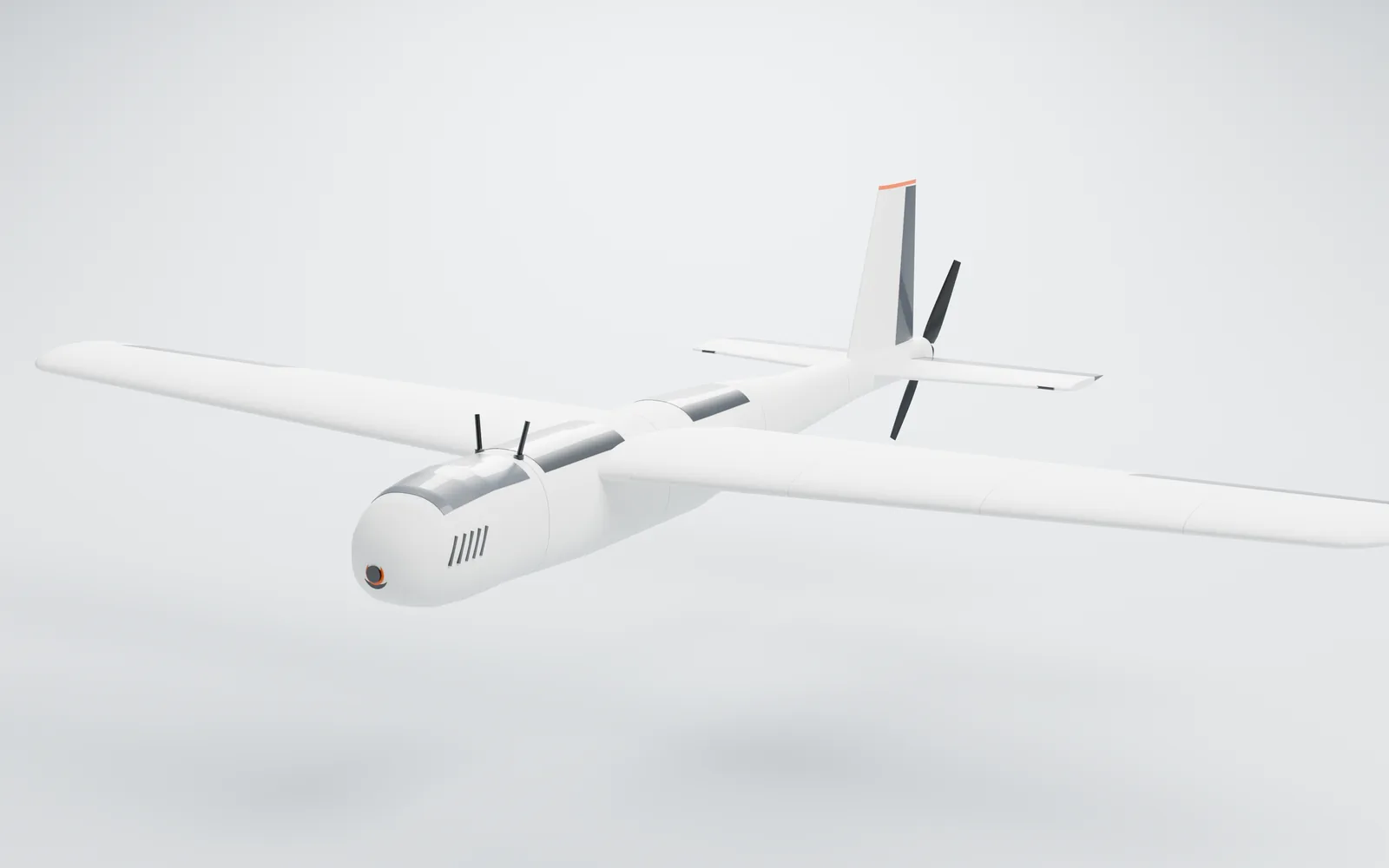
The main LayerWings plane and big brother of the Chakor 1300. Its 1.65 m wing gives 36 dm² of lift, and it flies at a balanced weight of about 1.8 kg with a 4S2P Li-ion, so it's steady in wind without being heavy to launch. It has the same family details: egg nose with a flush DJI O3 camera port and side vents, three magnetic hatches, side plug-in wing on 2 carbon joiners, one aileron per side and a folding pusher. There are no ribs inside: printed shells are glued together and 2 carbon tubes per wing give the strength. A VTOL version comes next. All sizes are in millimetres.
- Wingspan
- 1650 mm
- Length
- 1120 mm
- Wing area
- 36.0 dm²
- Flying weight
- ≈ 1850 g
- Printed parts
- 37
- Print time
- ≈ 44 h
Turn it around
Drag to rotate. Open the parts or look inside the skin.
Where everything goes
The camera, battery, autopilot, servos and every carbon tube, shown in place.
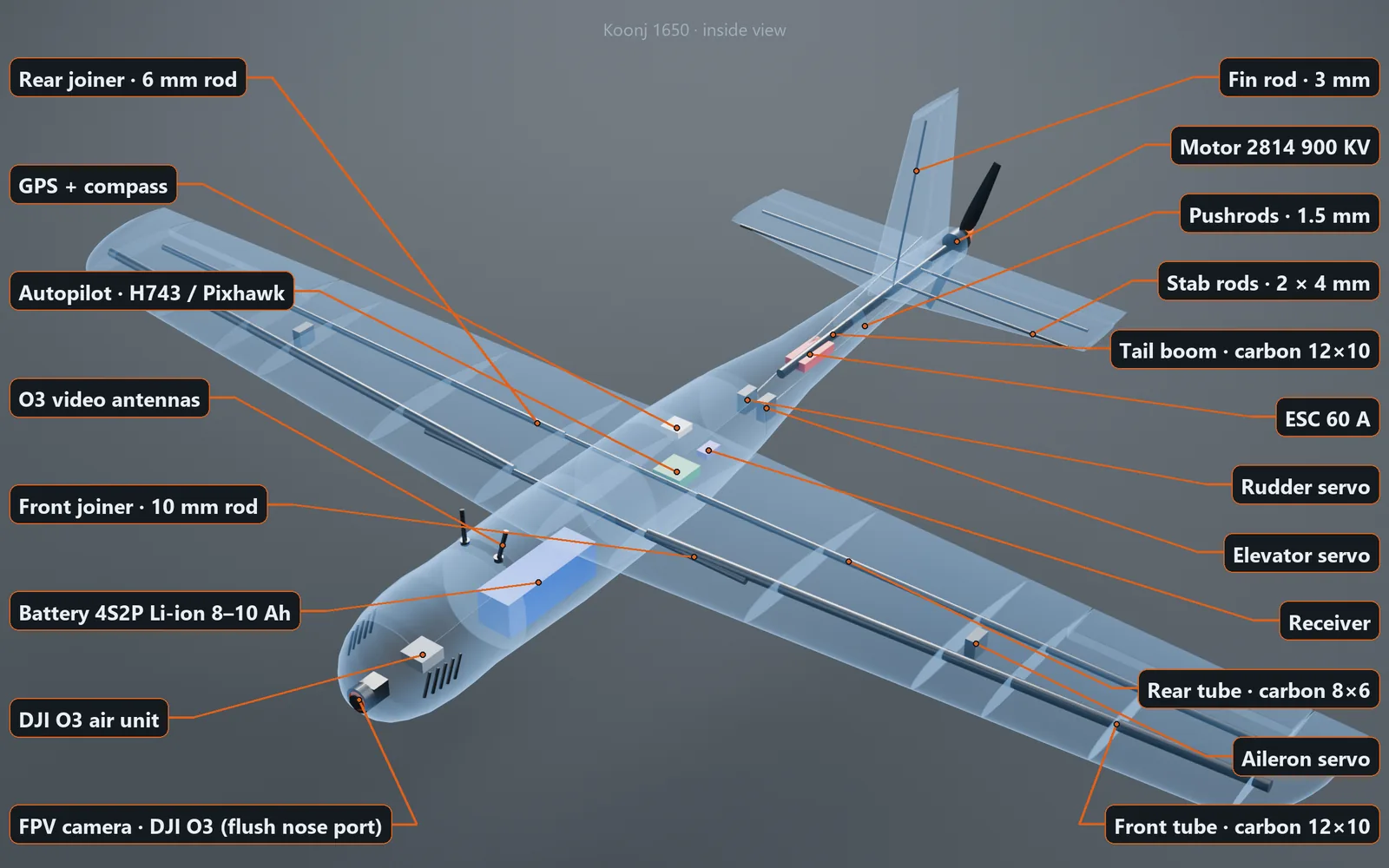
X-ray view · camera, battery, autopilot, servos, tubes and joiners
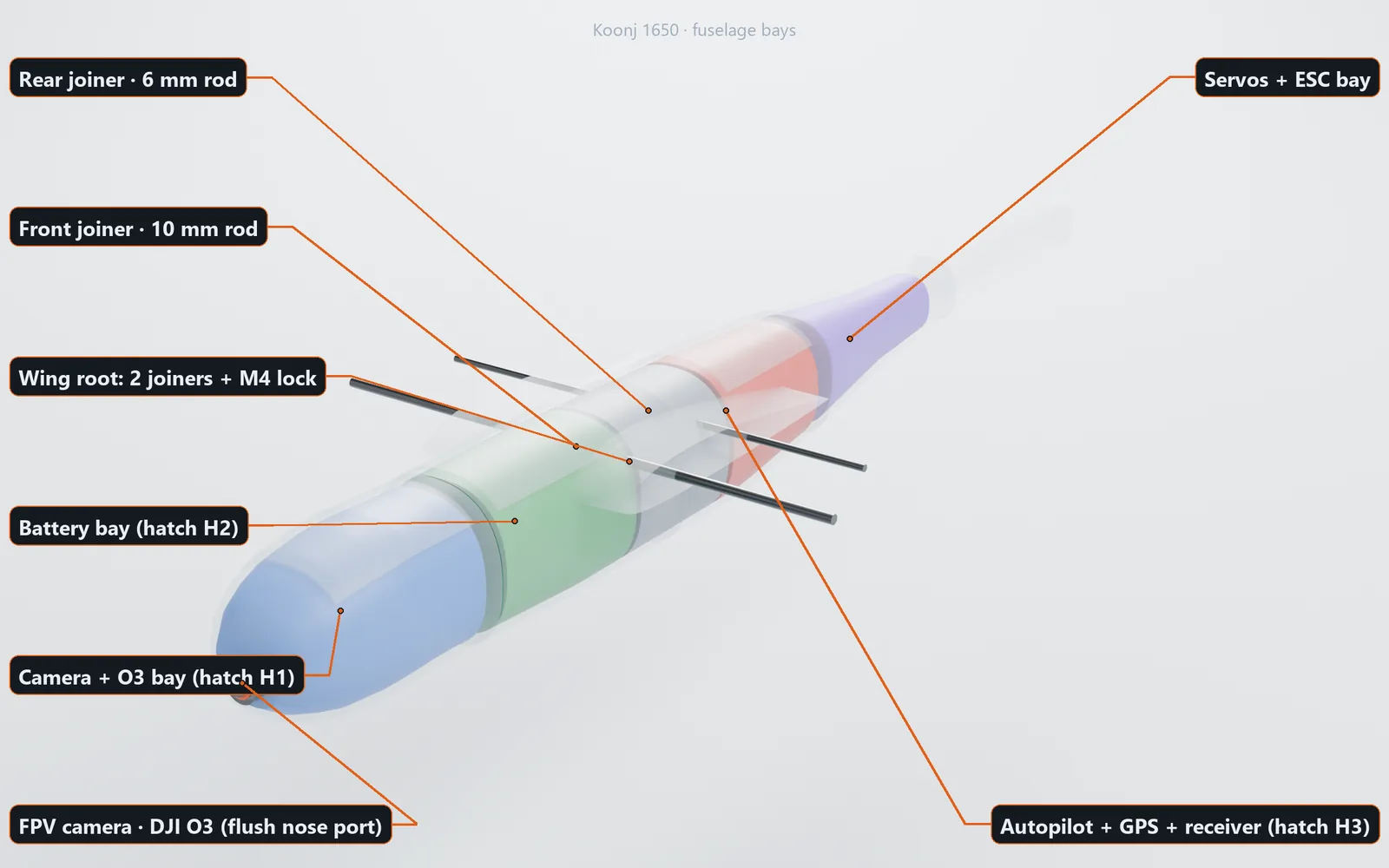
Fuselage bays · camera, battery, wing root, autopilot, servos + ESC
Dimensions and CG
Dashed orange lines show where the parts split for printing. The CG mark is your balance point.
Numbers and setup
| Airframe | Value |
|---|---|
| Wingspan | 1650 mm |
| Overall length | 1120 mm |
| Height | 311 mm |
| Root / tip chord | 270 / 170 mm, rounded tips |
| Wing area | 36.0 dm² |
| Aspect ratio | 7.6 |
| Mean chord (MAC) | 223 mm |
| Airfoil | NACA 2412 (12% thick) |
| Wing mount | Side plug-in, shoulder height, 4 sections per side |
| Dihedral | 1.5° each side |
| Stab / fin | 6.8 dm² / 2.8 dm² |
| Tail volume (H / V) | 0.51 / 0.028 |
| Flying weight (est.) | ≈ 1850 g |
| Wing loading | 52 g/dm² |
| Stall speed (est.) | 8.1 m/s (29 km/h) |
| CG | 81 mm behind wing LE at the root |
| CG safe range | 73–87 mm behind LE |
| Max lift coefficient (est.) | 1.29 |
| Best lift/drag (est.) | 15.9 at 42 km/h |
| Static margin (est.) | 23% of mean chord |
| Electronics & setup | Value |
|---|---|
| FPV | DJI O3 air unit, camera fixed forward in the nose |
| Autopilot | Matek H743-WING or Pixhawk 6C mini + M10 GPS |
| Motor | 2814 900 KV outrunner (pusher) |
| Propeller | 10 × 6 in folding pusher |
| ESC | 60 A with 5 V BEC |
| Battery | 4S2P Li-ion 21700, 8000–10000 mAh, under H2 (or 4S 5000 LiPo) |
| Servos | 4 × 12 g metal gear (2 wing, 2 tail) |
| Receiver | ELRS or any 4+ channel |
| Weight range | 1.6 kg (LiPo) to 2.4 kg (Li-ion + payload) |
| Launch / landing | Firm hand launch · belly landing on skid |
| Cruise speed (est.) | 55–75 km/h |
| Flight time (est.) | 60–90 min on Li-ion |
| Throws | Aileron ± 12 mm · elevator ± 9 mm · rudder ± 16 mm |
Connect it once, right
ArduPlane channel map, power path and data links, drawn on the real airframe.
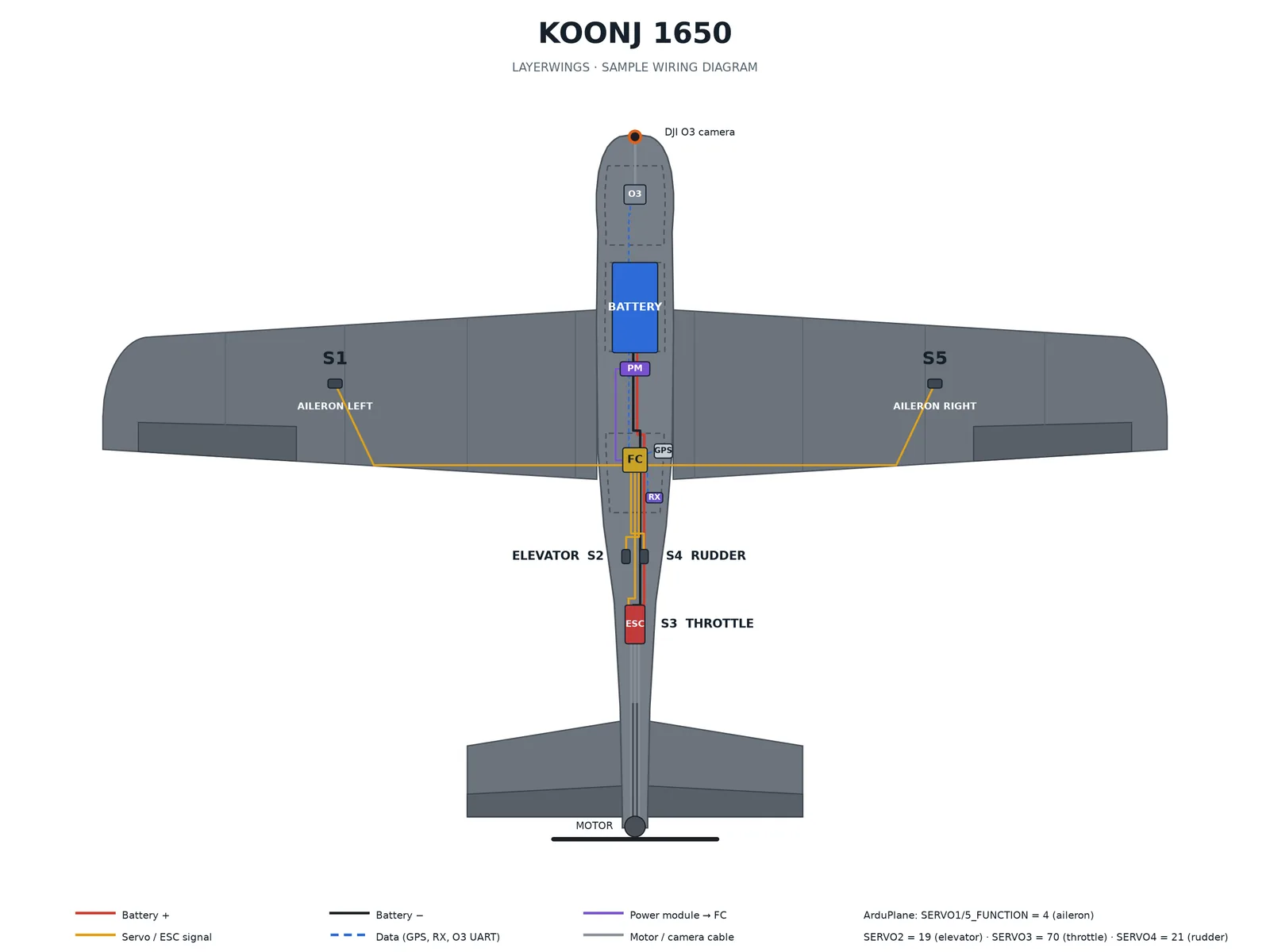
Sample wiring · S1 aileron left, S2 elevator, S3 throttle, S4 rudder, S5 aileron right
How it flies, on paper
Computed for the real geometry: NeuralFoil airfoil data, lifting-line wing, tail and fuselage build-up. An estimate until our flight tests confirm it.
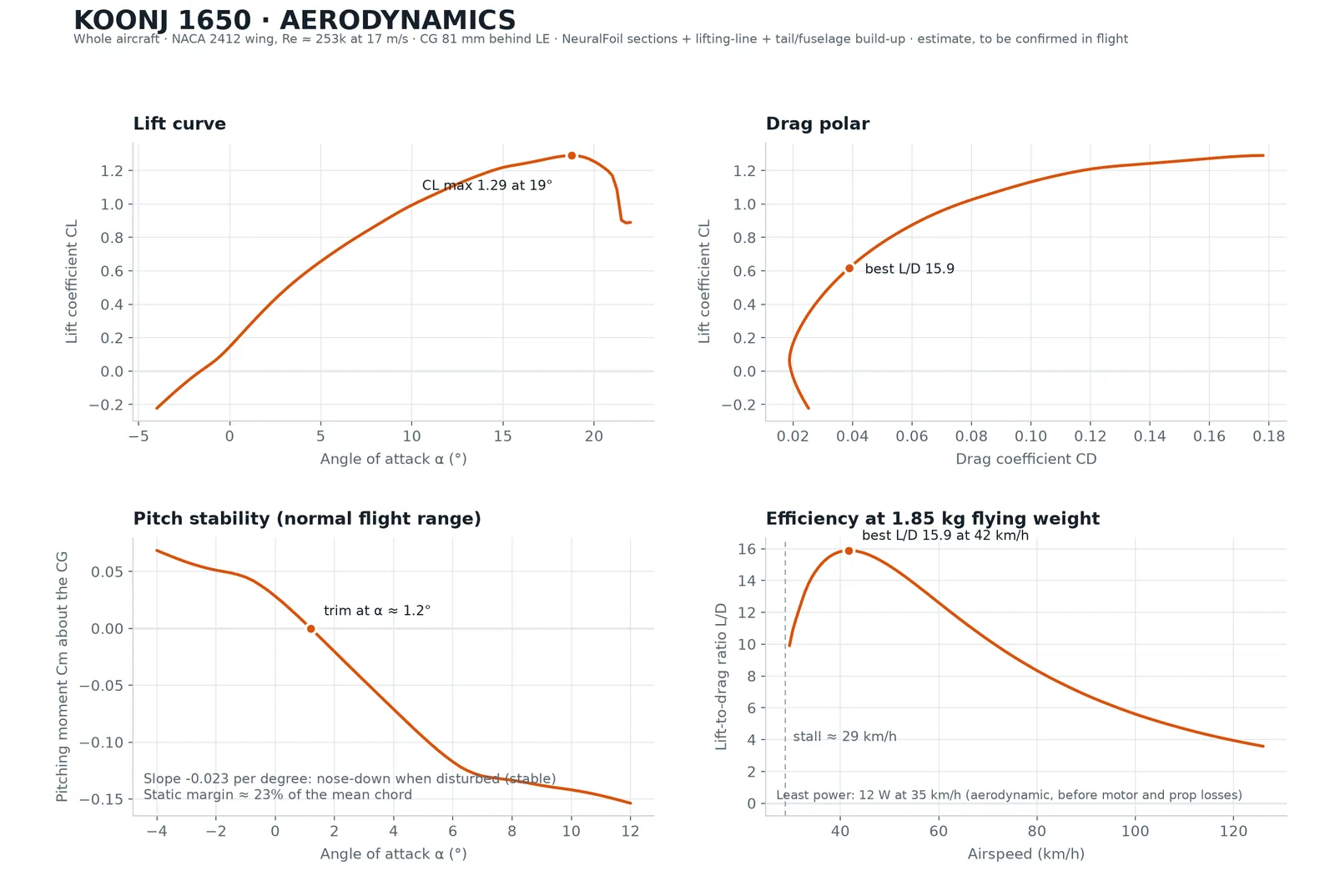
Lift curve · drag polar · pitch stability · lift-to-drag versus airspeed
Parts, filament and carbon
4 wing sections per side and the one-piece ailerons print standing up; wing sections are turned diagonally so the 270 mm root chord still fits a 220 × 220 mm bed (250 mm height). Weights are estimates.
| Code | Part | Qty | Size (mm) | Filament | Each |
|---|---|---|---|---|---|
| Fuselage (printed upright) | |||||
| F1 | Egg nose + flush camera port + side vents | 1 | 187 × 120 × 124 | LW-PLA | 32 g |
| F2 | Battery bay (fits 4S2P Li-ion) | 1 | 211 × 120 × 129 | LW-PLA | 52 g |
| F3 | Wing root stubs (airfoil) + joiner sleeves | 1 | 211 × 184 × 127 | LW-PLA | 70 g |
| F4 | Rear pod + tail servos | 1 | 234 × 115 × 115 | LW-PLA | 44 g |
| F5 | Tail boom + motor mount seat | 1 | 234 × 53 × 58 | LW-PLA | 26 g |
| H1 | Camera hatch (nose) | 1 | 129 × 92 × 22 | LW-PLA | 5 g |
| H2 | Battery hatch | 1 | 143 × 94 × 20 | LW-PLA | 7 g |
| H3 | Autopilot hatch | 1 | 129 × 92 × 20 | LW-PLA | 6 g |
| Wing (side plug-in halves, 4 sections each, printed standing, diagonal) | |||||
| W1 | Root section + root rib (L/R) | 2 | 168 span · 265 chord | LW-PLA | 53 g |
| W2 | Inner mid section (L/R) | 2 | 190 span · 245 chord | LW-PLA | 50 g |
| W3 | Outer mid section (L/R) | 2 | 190 span · 222 chord | LW-PLA | 42 g |
| W4 | Tip section, rounded (L/R) | 2 | 195 span · 200 chord | LW-PLA | 32 g |
| A1 | Aileron, one piece (L/R) | 2 | 245 × 64 × 11 (standing) | LW-PLA | 11 g |
| Tail | |||||
| S1 | Stabiliser half (L/R) | 2 | 260 span · 103 chord (standing) | LW-PLA | 16 g |
| E1 | Elevator half (L/R) | 2 | 248 × 49 × 9 (standing) | LW-PLA | 7 g |
| V1 | Fin | 1 | 200 × 116 × 15 | LW-PLA | 16 g |
| R1 | Rudder | 1 | 196 × 60 × 9 | LW-PLA | 7 g |
| Strong parts | |||||
| M1 | Pusher motor mount (2814) | 1 | 70 × 60 × 35 | PLA | 18 g |
| J1 | Joiner sleeve + wing nut plates | 1 | 130 × 80 × 34 | PLA | 18 g |
| C1 | DJI O3 camera bracket (20 mm) | 1 | 34 × 30 × 22 | PLA | 4 g |
| T1 | Autopilot + GPS tray | 1 | 90 × 70 × 45 | PLA | 10 g |
| SV | Servo frames | 4 | 40 × 30 × 15 | PLA | 3 g |
| HN | Control horns | 4 | 25 × 20 × 3 | PLA | 2 g |
| K1 | Belly skid (replaceable) | 1 | 210 × 34 × 12 | PLA | 14 g |
| 37 printed parts | LW-PLA 687 g · PLA 84 g | ||||
| Hardware | Size | Qty | Where |
|---|---|---|---|
| Front wing tube | Carbon tube 12 × 10 mm × 725 mm | 2 | At 25% chord, through all 4 sections of each wing |
| Rear wing tube | Carbon tube 8 × 6 mm × 685 mm | 2 | At 58% chord, through all 4 sections of each wing |
| Front joiner | Carbon rod 10 mm × 420 mm | 1 | Through the body, 150 mm into each front tube |
| Rear joiner | Carbon rod 6 mm × 360 mm | 1 | Through the body, 120 mm into each rear tube |
| Wing lock | M4 × 25 mm nylon bolt + nut plate | 2 | Through each root rib from underneath |
| Tail boom tube | Carbon tube 12 × 10 mm × 350 mm | 1 | Through F4 and F5, keeps the tail stiff |
| Stab rods | Carbon rod 4 mm × 490 mm | 2 | Front + rear, through the boom into both stab halves |
| Fin rod | Carbon rod 3 mm × 220 mm | 1 | From the boom up through the fin |
| Elevator / rudder pushrod | Steel wire 1.5 mm × 380 mm in 3 mm tube | 2 | F4 servos to the tail horns |
| Aileron pushrod | Steel wire 1.5 mm × 80 mm | 2 | Wing servo to aileron horn |
| Hinges | CA hinges 15 × 25 mm | 16 | 4 per aileron, 3 per elevator, 2 rudder |
| Hatch magnets | Neodymium 6 × 3 mm | 12 | 4 per hatch |
| Prop | 10 × 6 in folding pusher + 32 mm hub | 1 | Folds back for belly landings |
| Motor screws | M3 × 8 mm | 4 | Motor to M1 |
| Part | Wall | How it prints |
|---|---|---|
| Wing skin (no ribs inside) | 0.6 mm | LW-PLA shell, 1 perimeter at 0.6 mm line width, 0% infill. The curved shell carries the load |
| Tube channels (front + rear) | 0.8 mm | Printed sleeve from top skin to bottom skin, works as the shear web. 0.2 mm clearance on the tube |
| Root rib (wing side) | 1.2 mm | 3 perimeters, carries the joiners and the M4 bolt |
| Section end faces | 0.6 mm | Thin glue face with alignment keys, no inner ribs |
| Fuselage skin | 0.6 mm | LW-PLA, 1 perimeter |
| Fuselage ring frames | 0.8 mm | At each section joint only |
| Hatches | 0.8 mm | LW-PLA with PLA magnet seats glued in |
| Control surfaces | 0.45 mm | Single wall shell, 2 mm carbon rod in the hinge nose |
| Strong PLA parts | 1.6–2.4 mm | 4–6 perimeters, 30–40% gyroid infill |
How the parts join
Inside the wing
No ribs and no inner grid. Each of the 4 sections is a printed shell with 2 tube channels. Glue the sections together, then slide in the 12 × 10 front tube and the 8 × 6 rear tube. The shell shape plus 2 tubes give the strength.
Wing to body
Two joiners pass through the body: a 10 mm front rod and a 6 mm rear rod. Each wing half slides onto both, so it can't twist, and one M4 nylon bolt locks each root rib.
Hatches
Three magnetic top hatches: H1 nose camera hatch for the DJI O3, H2 battery hatch (fits a 4S2P 21700 pack), H3 autopilot + GPS hatch.
Tail
A 12 × 10 carbon tube stiffens the boom. Each stab half slides onto 2 × 4 mm rods through the boom, and a 3 mm rod runs up the fin. Straight hinge lines keep 34 mm clear of the 10-inch folding prop.
Be first to fly it
Get one email when Koonj 1650 is ready to download, plus the free Chiriya 600. No spam.