Hudhud VTOL
Any debit or credit card · no Payoneer account needed · Pakistan: bank, JazzCash, Easypaisa
The Hudhud takes off and lands straight up like a drone, then flies forward like a plane on one pusher motor. No runway, no hand launch. Built for civil work: mapping, survey, inspection and light delivery, with a 1.4 kg payload bay in the nose and about 40 minutes in the air on a Li-ion pack. Named after the hoopoe, the messenger bird.
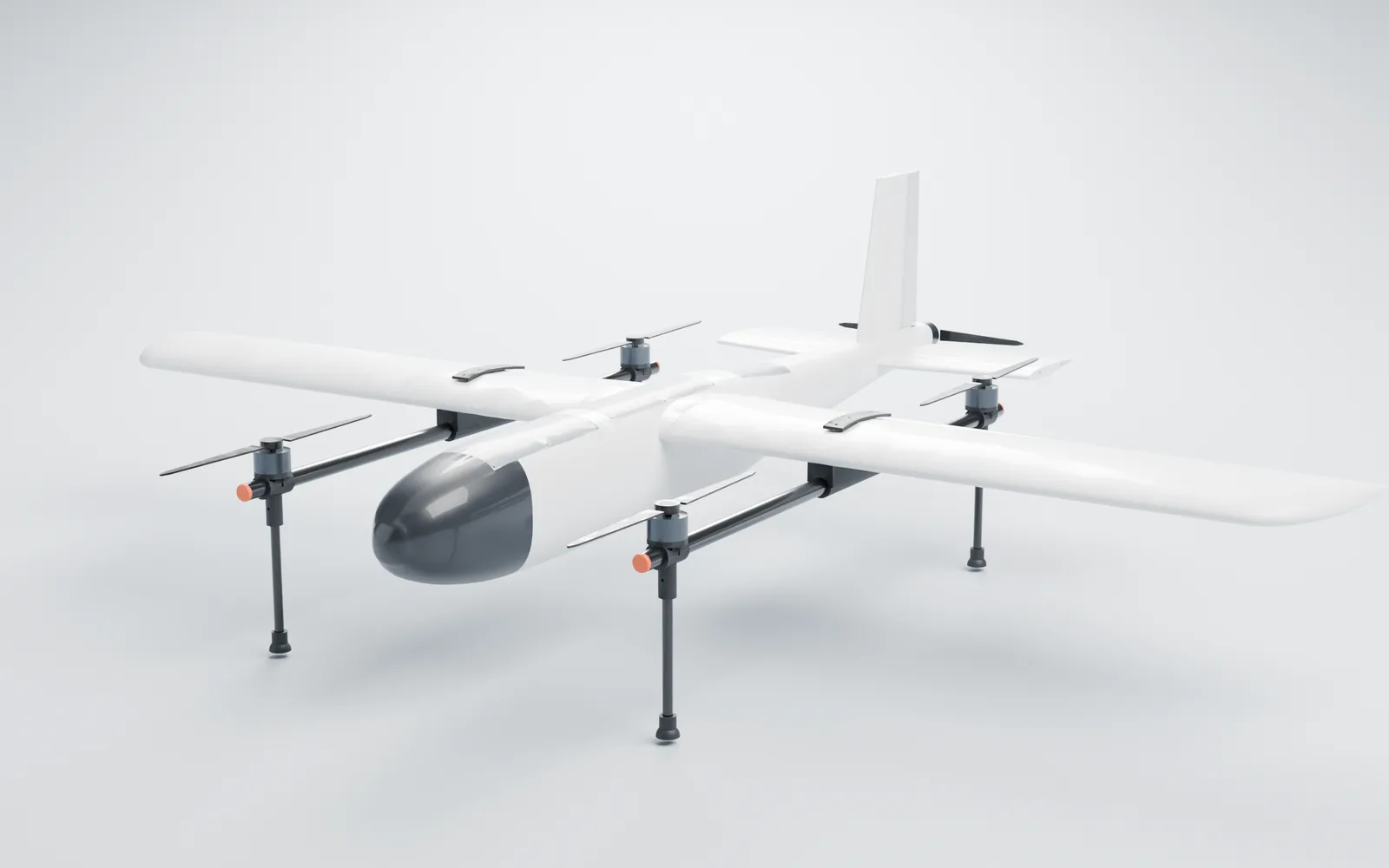
- Wingspan
- 1860 mm
- Length
- 1340 mm
- Take-off weight
- ≈ 8.1 kg
- Payload
- up to 1.4 kg
- Flight time
- ≈ 40 min*
- Cruise
- 19–20 m/s
- Lift
- 4 × 15" + 13" pusher
- Printed parts
- 47 · ≈ 2.8 kg
* Calculated 53–57 min at 19–20 m/s with the 20 Ah Li-ion pack. Plan on about 75 % in real flights until our flight tests confirm it.
Where everything goes
Every carbon tube, joint, fitting and piece of equipment, shown in place inside the see-through skin.
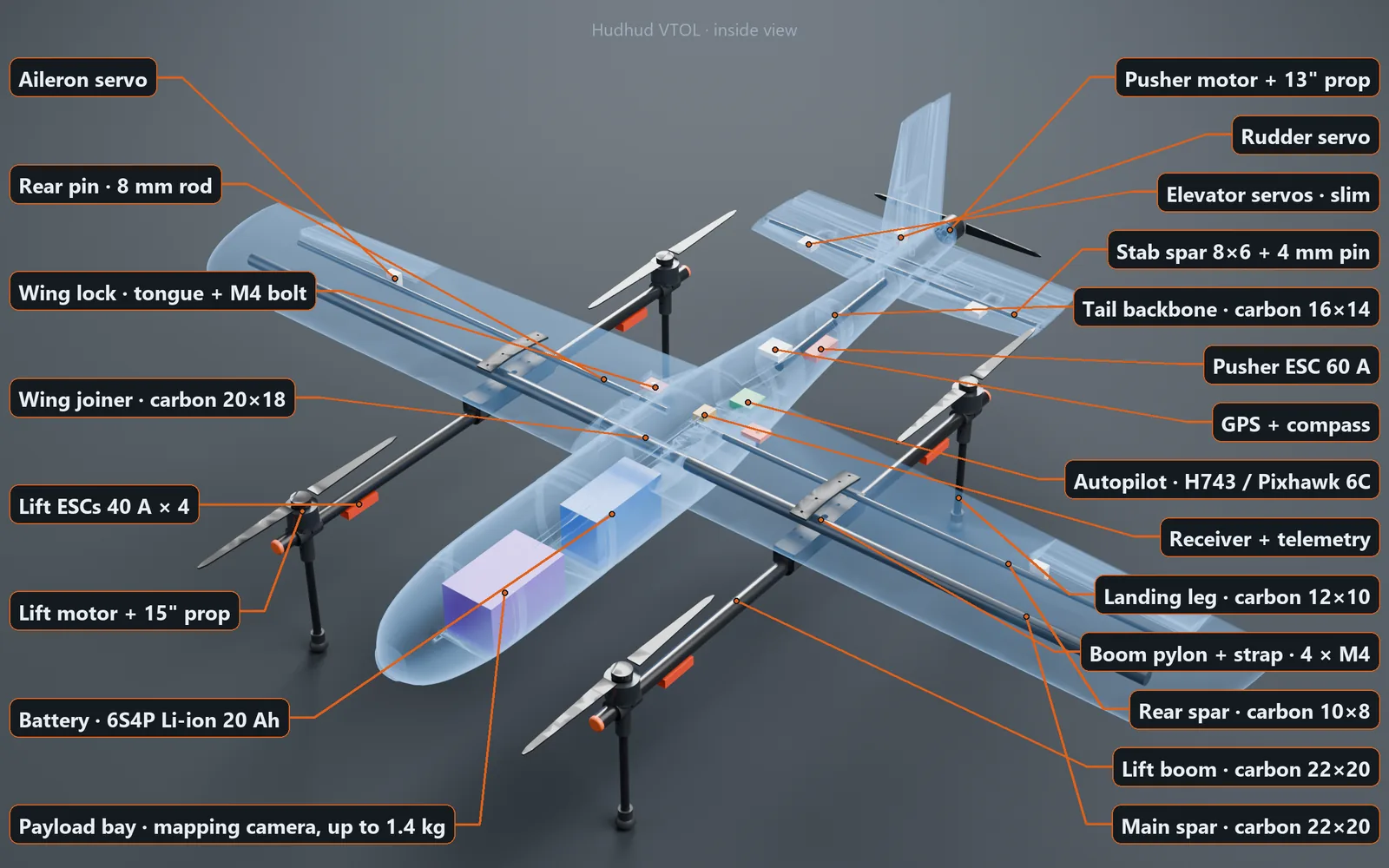
X-ray view · carbon joiner, spars, pins, booms and backbone, battery, payload, autopilot, GPS, ESCs, servos and the wing lock. Click to enlarge.
Dimensions and CG
Every number comes straight from the 3D CAD. The red dashed line is the balance point.
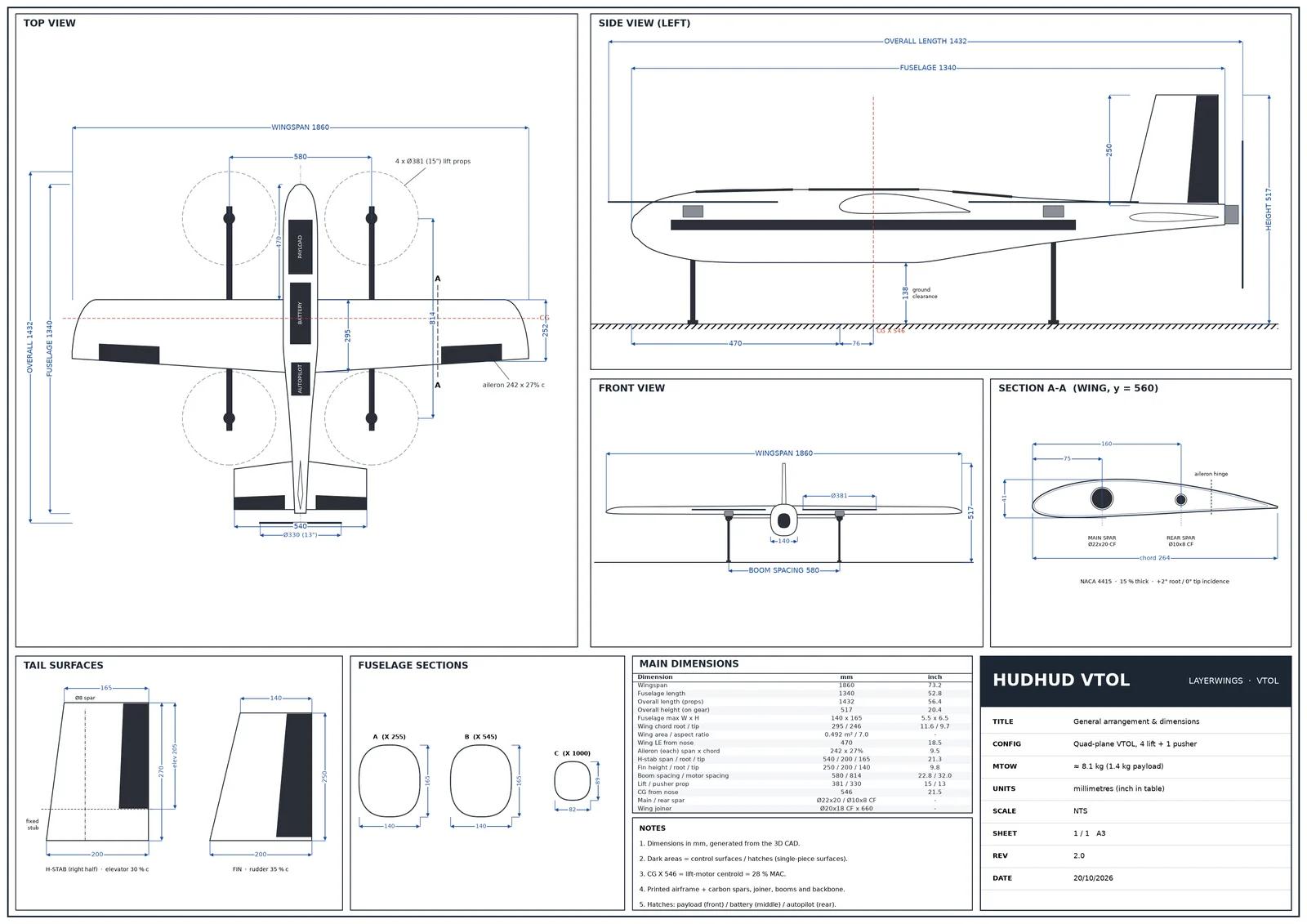
General arrangement · top, side and front views, wing section, tail and fuselage sections, main dimensions. Click to enlarge.
Numbers and setup
| Airframe | Value |
|---|---|
| Wingspan | 1860 mm (2 plug-in halves) |
| Fuselage | 1340 mm · 140 × 165 mm section |
| Wing | NACA 4415 · chord 300 → 240 mm · 0.49 m² · AR 7.0 |
| Mean chord (MAC) | 271 mm |
| Tail | Stab 0.099 m² (Vh 0.47) · fin 0.043 m² |
| Controls | 1 aileron per side, 2 elevators, 1 rudder |
| Take-off weight | ≈ 8.1 kg with 1.4 kg payload |
| Stall | ≈ 15 m/s · cruise 19–20 m/s |
| CG | 546 mm from the nose tip · 76 mm behind the wing LE · 28 % MAC |
| Print bed | 256 × 256 mm (Bambu A1 class) |
| Electronics & setup | Value |
|---|---|
| Lift motors × 4 | ≥ 3.7 kg thrust each · 6S · 15" props (4114–5008, 320–400 KV) |
| Lift ESCs × 4 | 40 A 6S |
| Pusher | 3515 / 4120 class · ~500 KV · 13 × 8 prop · 60 A ESC |
| Battery | 6S4P 21700 Li-ion, 18–20 Ah (≈ 1.75 kg) |
| Hover power | ≈ 1.35 kW / 60 A · climb peaks ≈ 100 A |
| Servos | 2 aileron, 2 slim elevator, 1 rudder, metal gear |
| Autopilot | ArduPilot quad-plane (Matek H743 / Pixhawk 6C) |
| ArduPilot | Q_ENABLE 1 · Q_FRAME_CLASS 1 · Q_FRAME_TYPE 1 |
Bays and balance
A VTOL must balance on the lift motors, not only on the wing. The CG at X 546 is exactly the centre of the four lift motors.
| Hatch | Position | What goes in |
|---|---|---|
| 1 · Payload (front) | X 145–365 | Up to 150 × 90 × 90 mm on an M3 insert grid (20 mm pitch). Centre the payload at X ≈ 235. |
| 2 · Battery (middle) | X 400–650 | 6S4P pack ≈ 145 × 68 × 90 mm under the wing joiner. Centre at X ≈ 465. |
| 3 · Autopilot (rear) | X 725–860 | FC tray with 30.5 and 20 mm M3 patterns, centred at X 792. |
With the 1.4 kg payload
Payload in the front bay, battery in the middle bay. Check by lifting the plane at the main spar (546 mm from the nose): it should hang level.
Without payload
Move the battery to the front bay. With an empty nose and the battery in the middle, the CG is about 70 mm too far back and the plane will flip in hover. Never drop the payload in flight with this layout.
How long it flies
Calculated with 2 minutes of hover and hot-day air. Real flights: plan on about 75 % of these numbers. The detailed aerodynamic report below also counts the drag of the round landing legs and gives a little less: about 46 min at 70 km/h, or 52 min at 65 km/h.
| Battery | Take-off weight | 19 m/s | 20 m/s |
|---|---|---|---|
| 6S4P P45B Li-ion 18 Ah | 8.05 kg | 51 min | 48 min |
| 6S4P P50B Li-ion 20 Ah | 8.09 kg | 57 min | 53 min |
| 6S 16 000 mAh LiPo | 8.38 kg | 43 min | 40 min |
How it flies, on paper
Computed on the real CAD geometry: a vortex-lattice model of the wing, NeuralFoil airfoil data (trained on XFOIL), and a drag build-up that counts every VTOL part: booms, motors, stopped props and legs. An estimate until our flight tests confirm it.
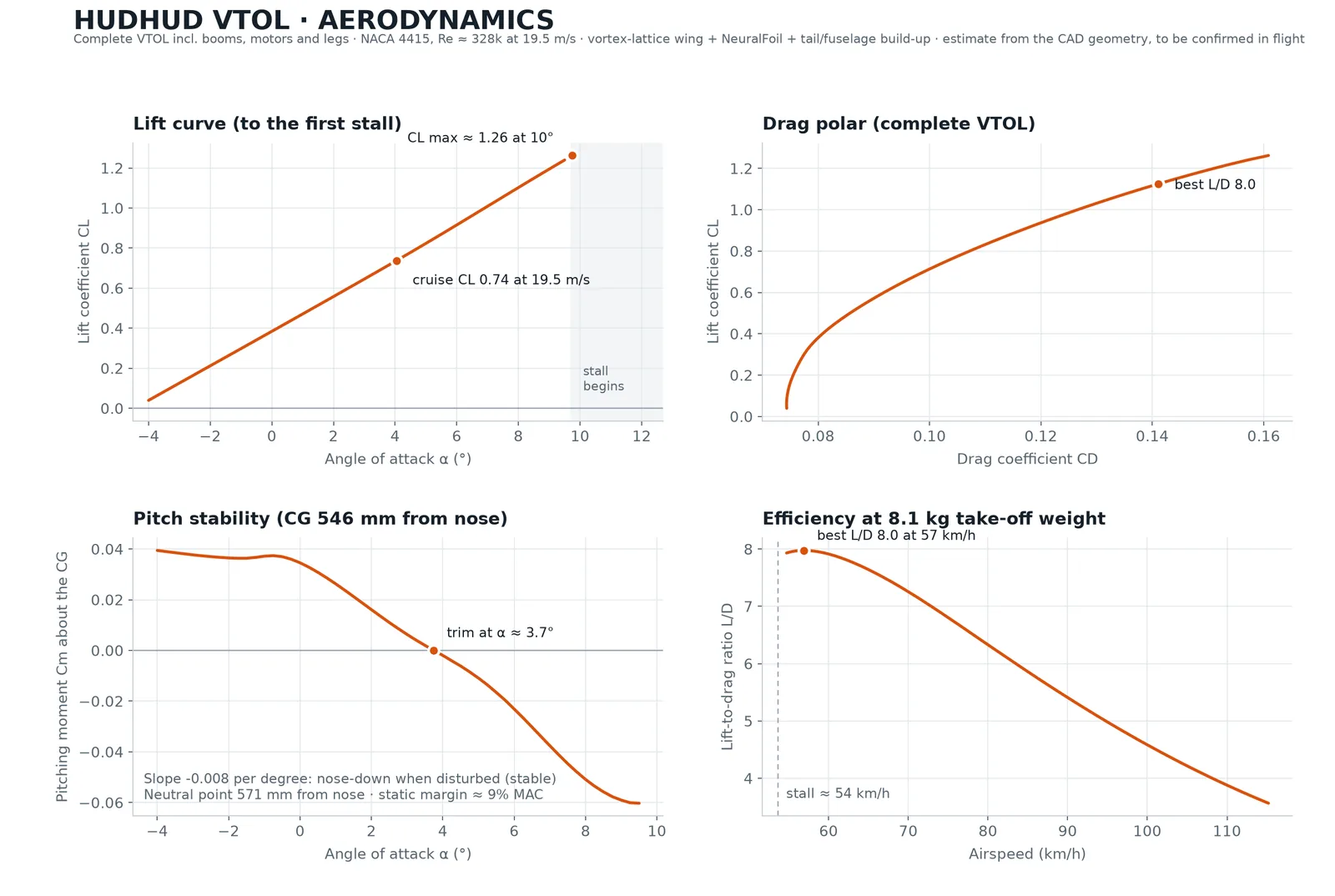
Lift curve, drag polar, pitch stability and lift-to-drag versus speed · click to enlarge
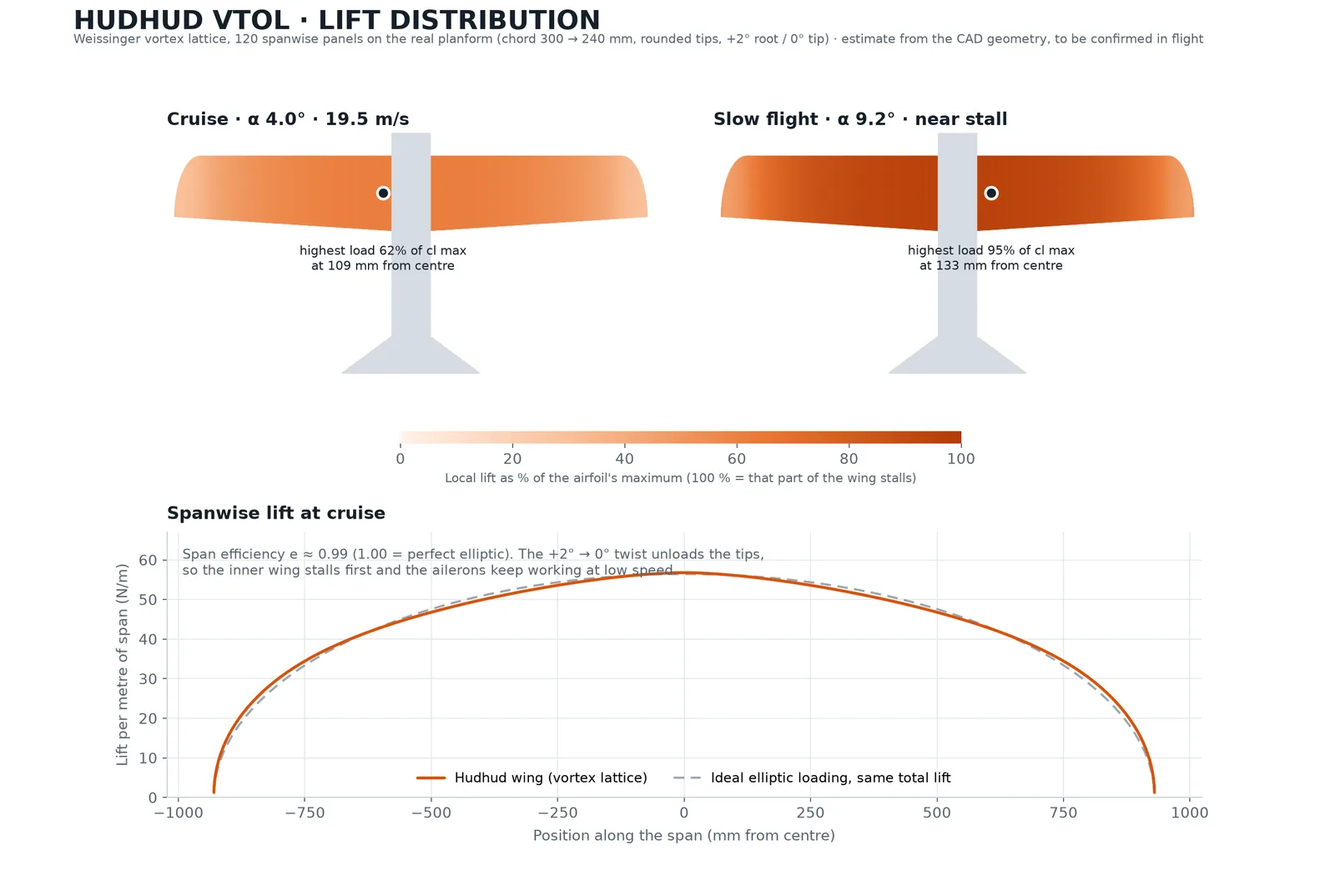
Lift along the span and stall margin on the wing (vortex lattice) · click to enlarge
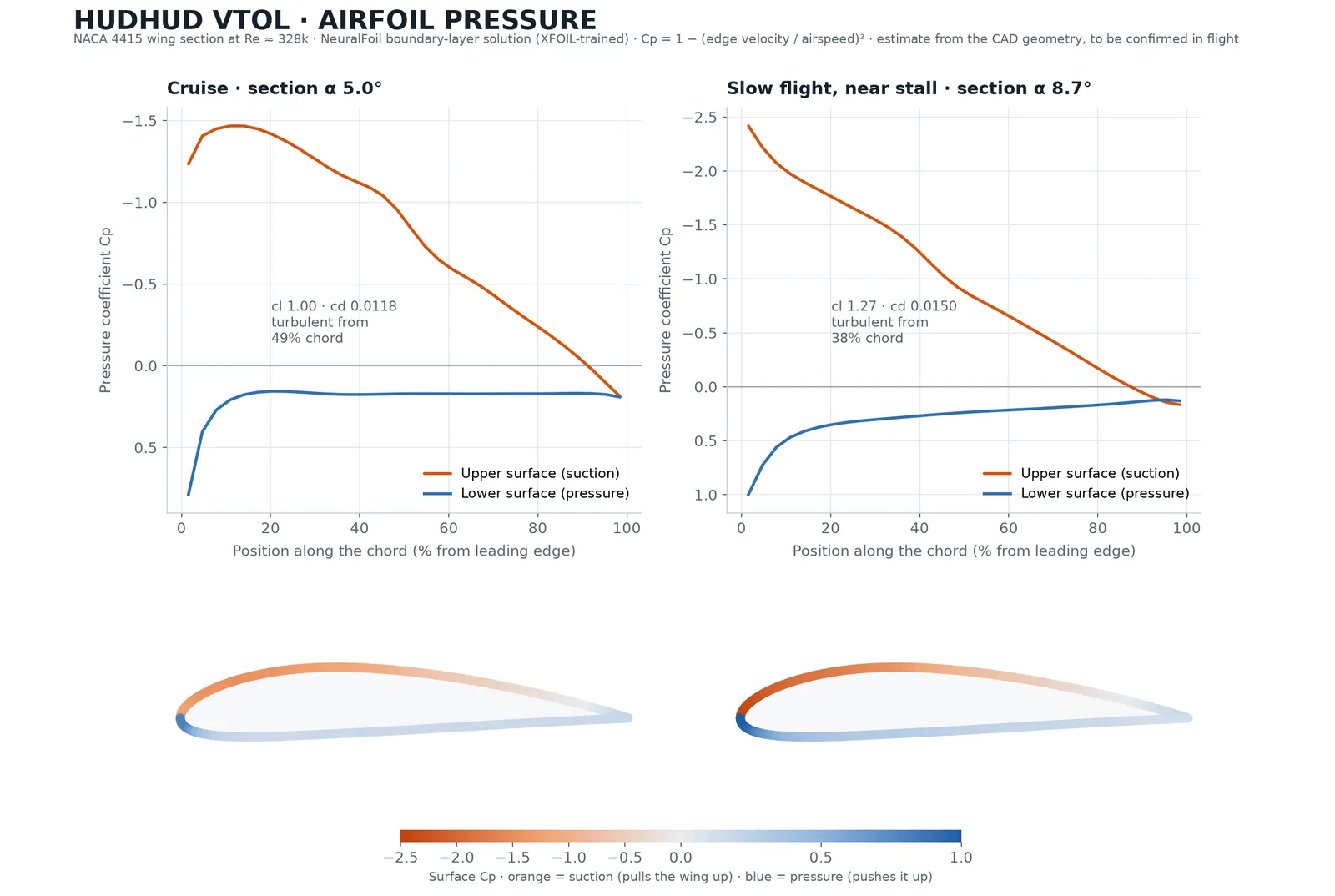
Pressure on the NACA 4415 airfoil in cruise and near stall · click to enlarge
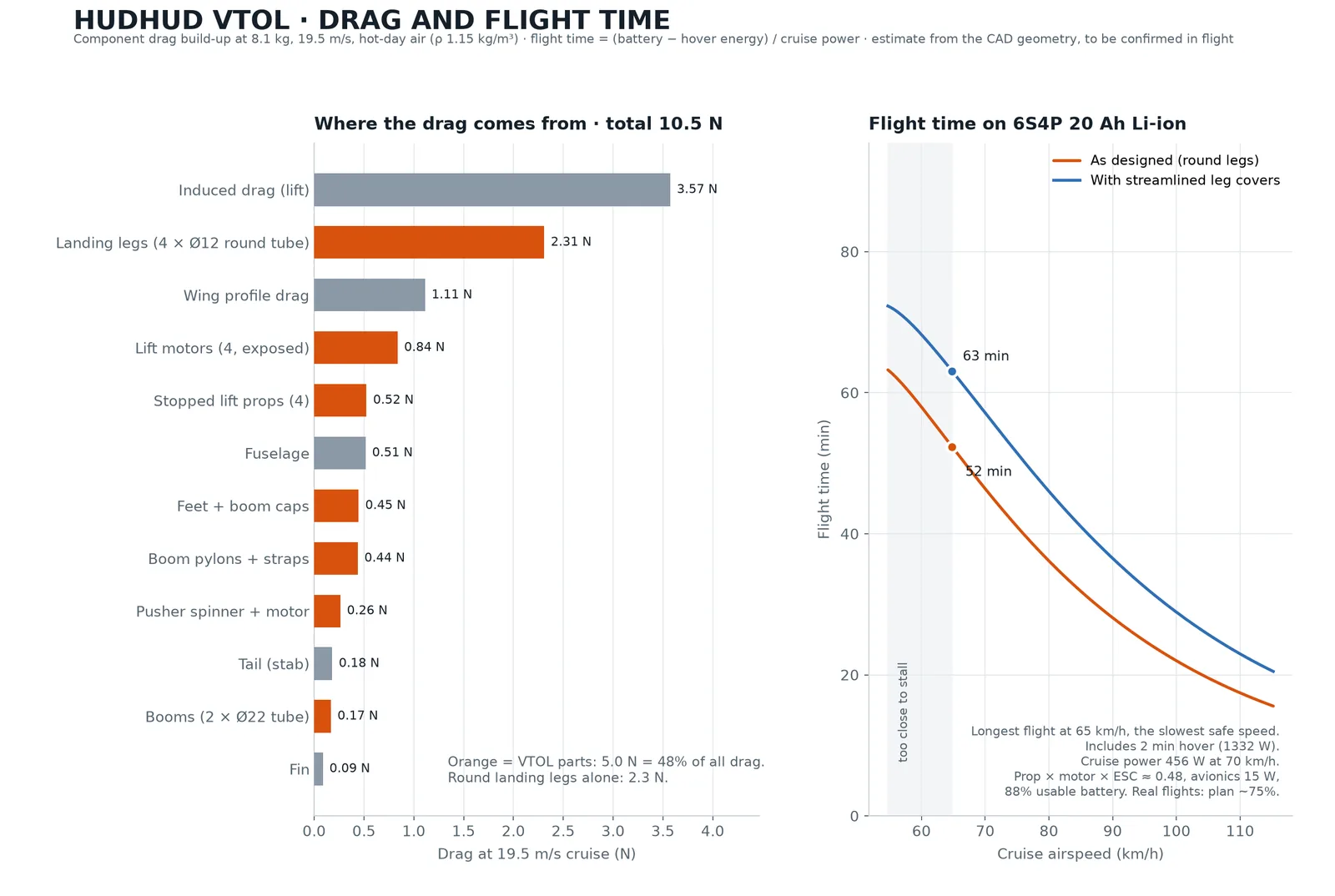
Where the drag comes from, and flight time versus speed · click to enlarge
Stable in pitch
Neutral point 571 mm from the nose, so the CG at 546 mm gives a static margin of about 9.3 % of the mean chord. It trims at α ≈ 3.7° in cruise.
Safe stall
The twist (+2° root, 0° tip) makes the inner wing stall first, so the ailerons keep working. Stall ≈ 54 km/h; never cruise slower than 65 km/h. Span efficiency ≈ 0.99.
VTOL parts cost range
Booms, motors, stopped props and legs make about 48 % of the cruise drag. Best L/D is 8.0, lower than a clean plane, which is normal for a quad-plane.
Easy upgrade: leg covers
The four round legs alone cause more drag than the whole wing's skin friction. Streamlined (airfoil) leg covers lift the calculated flight time from 52.3 to about 63.1 min.
Print settings and carbon
Every printed part fits a 256 × 256 mm bed. Wings and tail in LW-PLA; parts that carry load in PETG.
| Parts | Filament | Settings |
|---|---|---|
| Wing, ailerons, stab, elevators, fin, rudder | LW-PLA | 2 walls, 0 % infill, standing on the root rib |
| Fuselage FUS-3 / FUS-4 (wing stub + joiner sleeve) | PETG | 4 walls, 20 % infill |
| Other fuselage parts + 3 hatches | LW-PLA | 3 walls, 0–5 % infill |
| Boom pylons, straps, motor mounts, boom caps | PETG / PETG-CF | 5 walls, 40–100 % |
| Tail snap clips | PETG | 100 %, must flex |
| Landing feet | TPU 95A |
| Qty | Carbon | Length | Use |
|---|---|---|---|
| 2 | Tube 22 × 20 | 745 | Main spars |
| 2 | Tube 22 × 20 | 915 | Lift booms |
| 1 | Tube 20 × 18 | 660 | Wing joiner |
| 2 | Tube 10 × 8 | 725 | Rear spars |
| 2 | Rod Ø8 | 150 | Rear pins |
| 4 | Tube 12 × 10 | 200 | Landing legs |
| 1 | Tube 16 × 14 | 290 | Tail backbone |
| 1 | Tube 8 × 6 | 520 | Stab spar |
| 1 | Tube 8 × 6 | 250 | Fin spar |
How the parts join
Wing to body
A Ø20 carbon joiner runs through the body and 250 mm into each wing's main spar. An 8 mm rear pin stops twist, and one M4 bolt from under each wing locks a printed tongue.
Booms to wing
Each 22 mm lift boom is clamped between a pylon under the wing and a strap on top by 4 × M4 bolts that straddle both spars, so motor loads go into the carbon, not the skin.
Tail
The stab halves slide onto an 8 mm spar and a 4 mm pin through the tail stub, then a PETG snap clip holds them. Pull the little lip to take them off.
Control surfaces
Every aileron, elevator and the rudder is a single printed piece on CA hinges, stiffened by a thin carbon rod.
What you get
Sent by email after purchase. Files are for personal use; print and fly as many as you like.
- 15 Bambu Lab plates (.3mf), parts already placed and oriented for a 256 mm bed (A1 / P1S / P1P / X1C)
- Print guide: filament and settings for every plate (LW-PLA, PETG, TPU)
- 47 STL parts in assembly position + all carbon tubes
- STEP files of every part + the full assembly, for editing
- Build manual: wing lock, booms, tail clips, hinges, balance rules, electronics and ArduPilot setup
- A3 general-arrangement drawing, x-ray, renders and aero report
Hudhud VTOL STL files
Print it on any Bambu Lab printer, add carbon tubes and electronics, fly it with ArduPilot.
Any debit or credit card · no Payoneer account needed · Pakistan: bank, JazzCash, Easypaisa