Cheel 1200
Instant download link by email · secure card payment by Payoneer
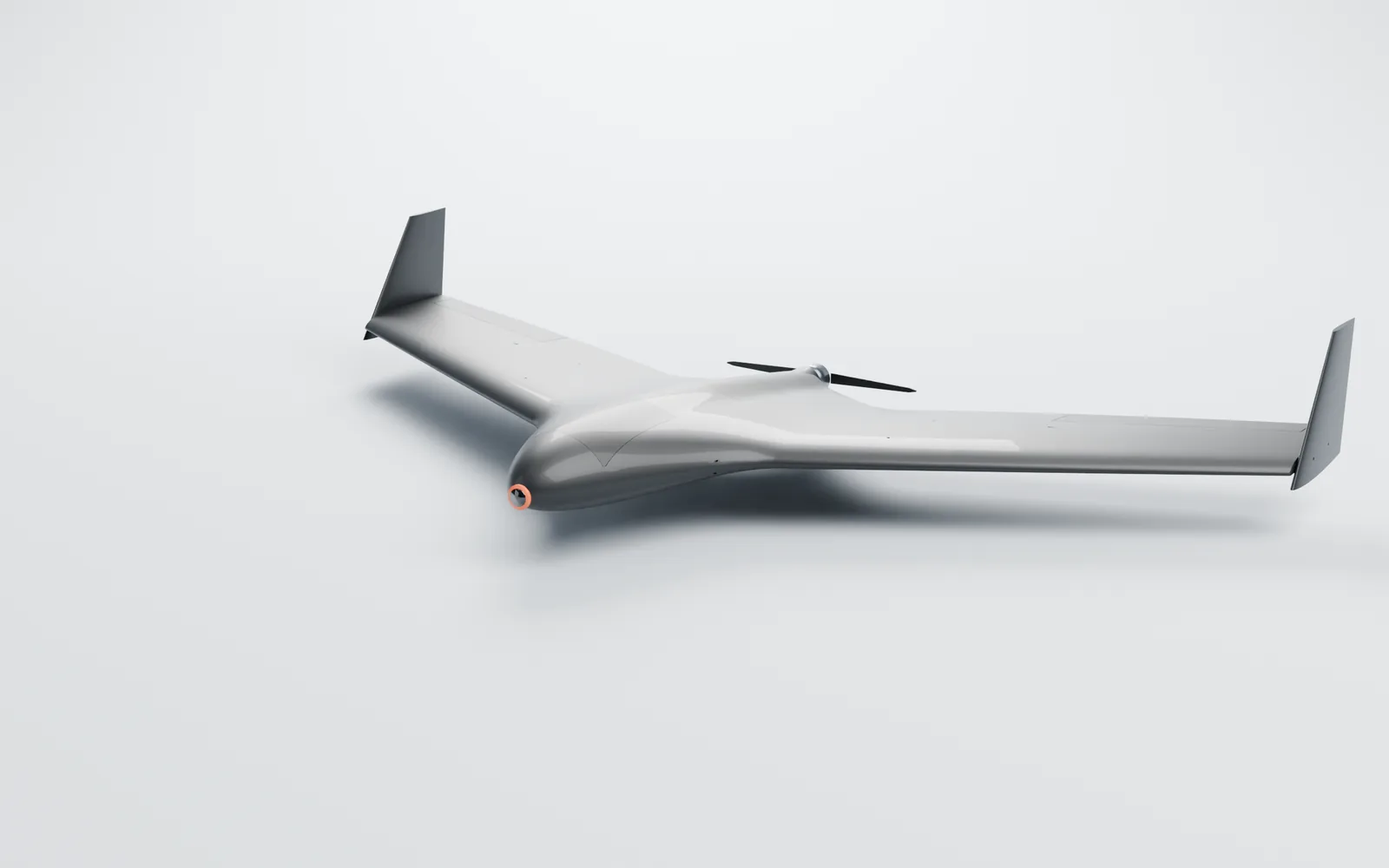
A sleek blended wing-body flying wing: the wide lifting body flows into slim swept wings, with winglets and a folding pusher. Built for long-range FPV and mapping, it hand-launches and belly-lands, and prints on any Bambu Lab printer.
- Wingspan
- 1200 mm
- Length
- 566 mm
- Wing area
- 31.9 dm²
- Take-off weight
- ≈ 1.50 kg
- Flight time
- ≈ 95 min*
- Cruise
- 58 km/h
- Take-off
- hand launch
- CG
- 315 mm from the nose
* Plan figure = 75 % of the calculated 126 min at 58 km/h cruise. Estimate until flight-tested.
Where everything goes
Carbon spars, battery, autopilot, servos, wing lock and the internal ribs, shown in place.
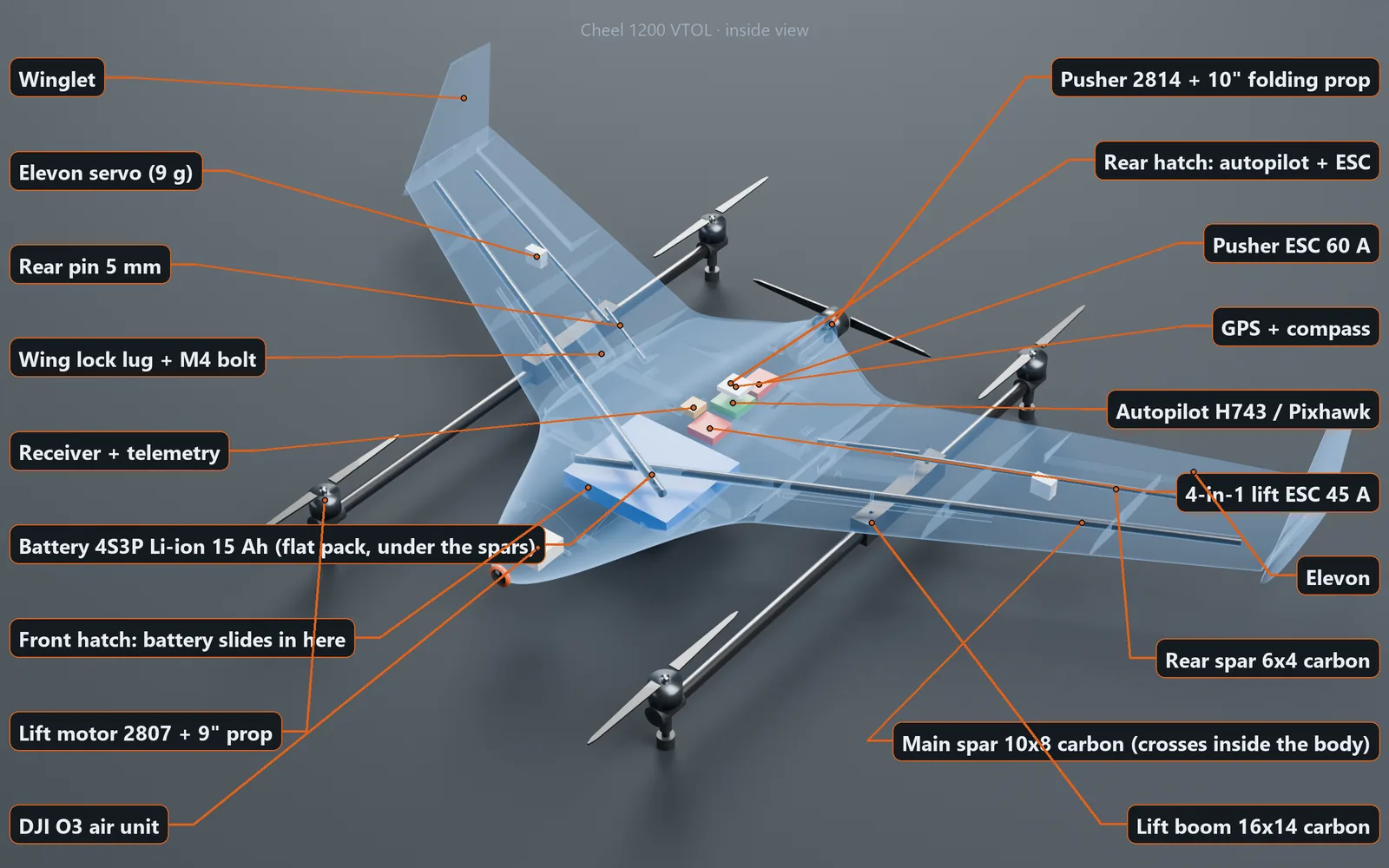
X-ray of the VTOL version · the pusher version is the same without booms and lift motors · click to enlarge
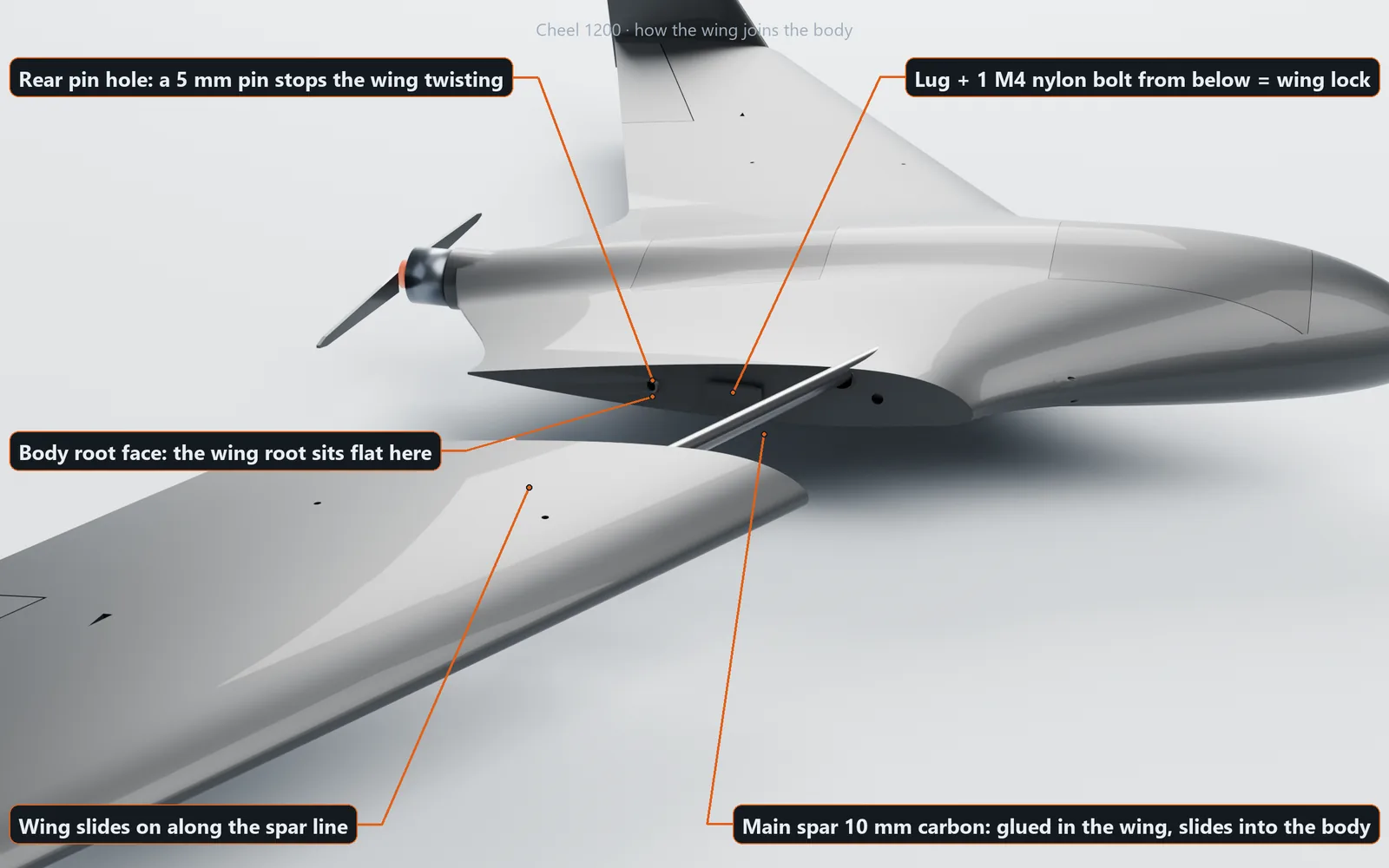
How the wing joins the body · click to enlarge
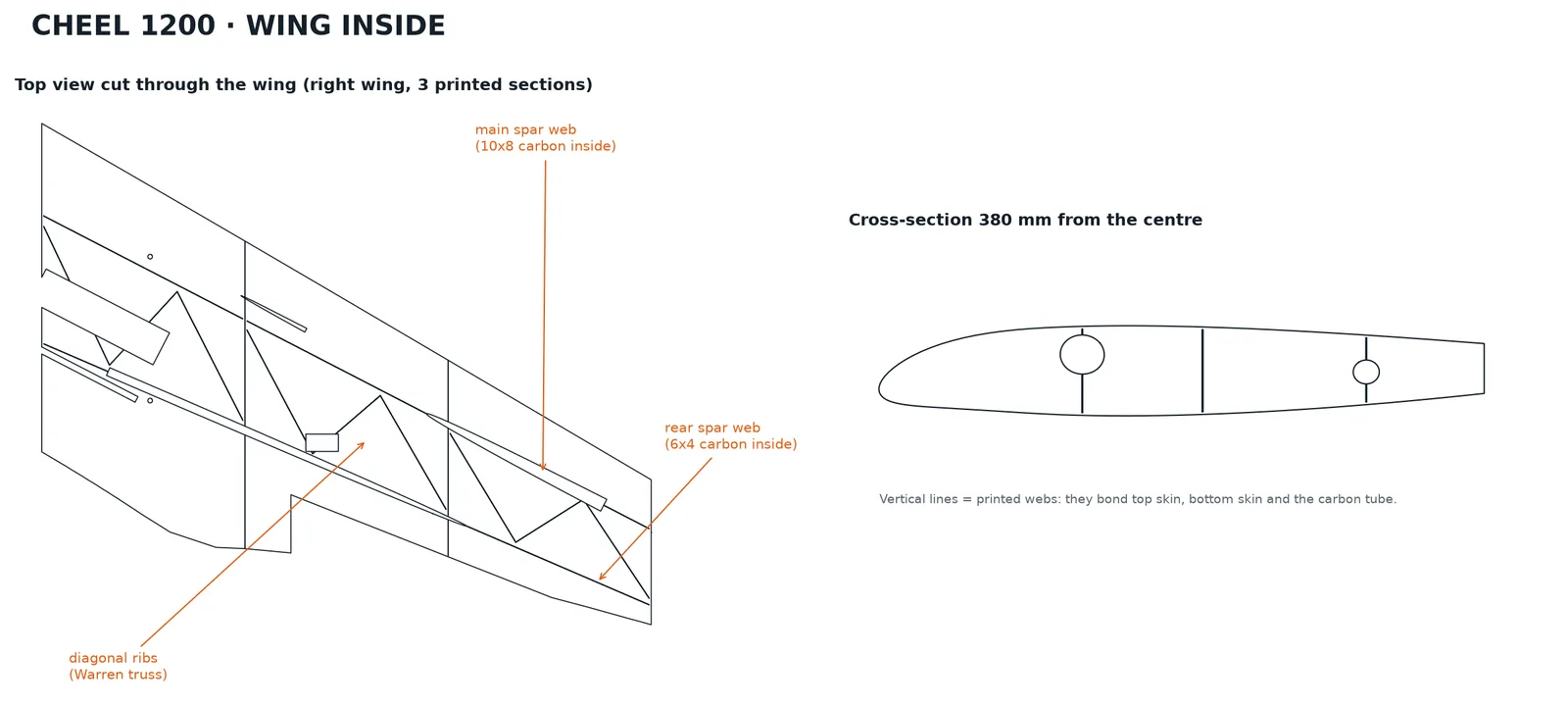
Inside the wing: spar webs and diagonal ribs · click to enlarge
Dimensions and CG
Top, side and front views from the CAD. The red dashed line is the balance point.
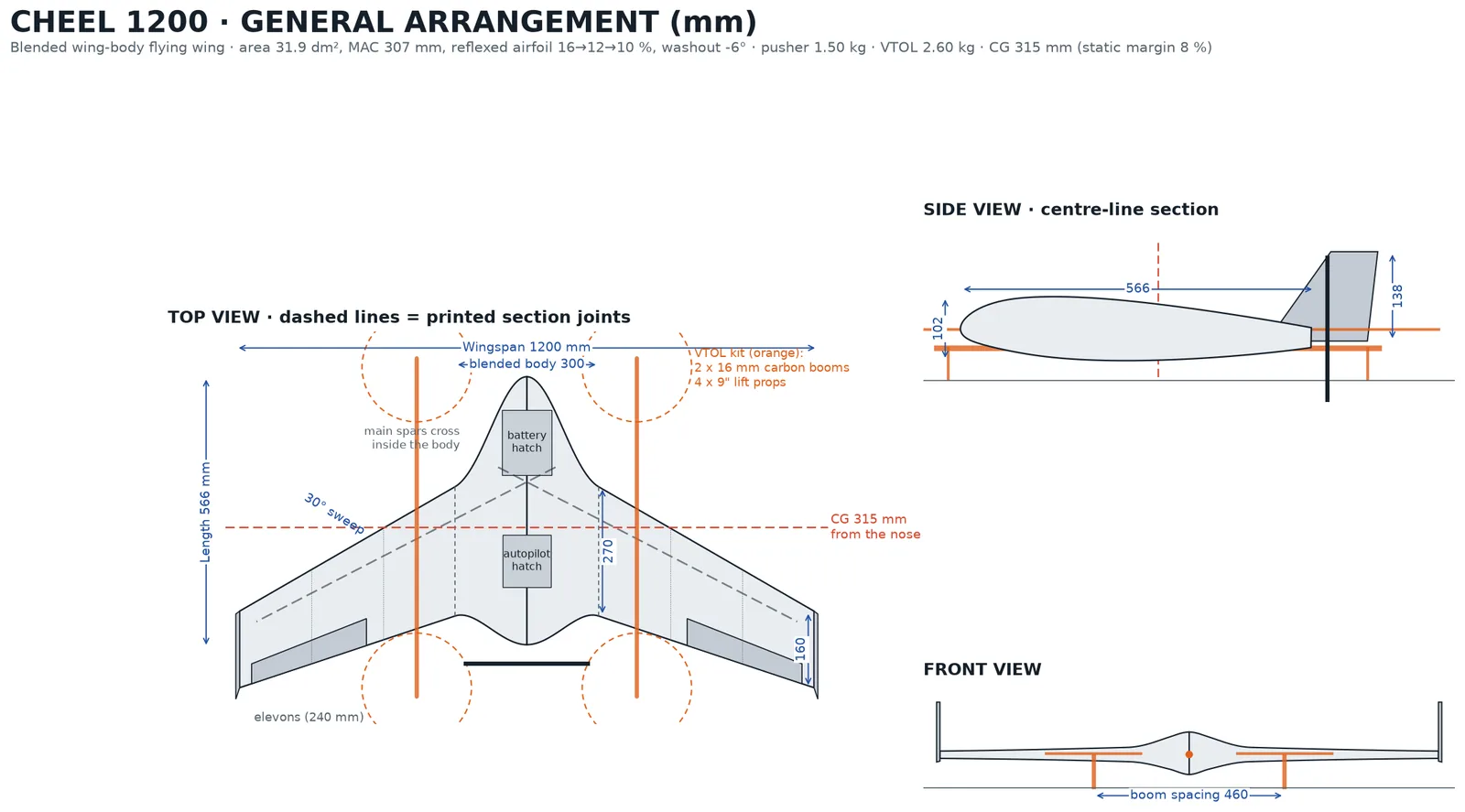
General arrangement · dashed lines are the printed section joints · click to enlarge
Numbers and setup
| Airframe | Value |
|---|---|
| Layout | Blended wing-body flying wing, winglets, pusher |
| Wingspan / length | 1200 mm / 566 mm |
| Wing area / MAC | 31.9 dm² / 307 mm |
| Sweep / washout | 30° leading edge / −6° at the tip |
| Airfoil | Reflexed (self-stable), 16 % body → 12 % wing root → 10 % tip |
| CG | 315 mm behind the nose tip · neutral point 340 mm · static margin 8 % |
| Elevon trim | ≈ 5° up at cruise (normal for a flying wing) |
| Take-off weight | ≈ 1.50 kg |
| Wing loading | 46.9 g/dm² |
| Stall | ≈ 33 km/h |
| Electronics & setup | Value |
|---|---|
| Pusher | 2814 900 KV + 10 x 6 folding prop, 60 A ESC |
| Battery | 4S2P 21700 Li-ion, single-layer flat pack, slides in under the spars |
| Servos | 2 x 9 g metal gear (elevons) |
| FPV | DJI O3 air unit, camera in the nose |
| Autopilot | ArduPilot (Matek H743 / Pixhawk) in the rear hatch |
| Launch | Hand launch, belly landing |
Filament and print list
Every file comes rotated, flat and centred for Bambu Lab A1, P1S, P1P and X1C. Checked: fits the bed with 8 mm to spare, watertight, no supports on the wings, body, hatches or winglets. The A1 mini (180 mm) is too small.
| Filament | Amount | Used for |
|---|---|---|
| LW-PLA / Bambu PLA Aero | ≈ 550 g (one 1 kg spool is plenty) | Wings, body, hatches, elevons, winglets · 2 walls, 0 % infill |
| Part | On the bed (mm) | Filament | How it prints | Supports | ≈ g |
|---|---|---|---|---|---|
| BODY-1L | 94 x 115 x 188 | LW-PLA | 2 walls, 0 % infill, standing on the rear joint face, nose up | none | 14 g |
| BODY-1R | 94 x 115 x 188 | LW-PLA | 2 walls, 0 % infill, standing on the rear joint face, nose up | none | 14 g |
| BODY-2L | 187 x 188 x 155 | LW-PLA | 2 walls, 0 % infill, lying on the flat centre split face (tail block: 3 walls) | none | 41 g |
| BODY-2R | 188 x 187 x 155 | LW-PLA | 2 walls, 0 % infill, lying on the flat centre split face (tail block: 3 walls) | none | 41 g |
| BODY-3L | 167 x 168 x 152 | LW-PLA | 2 walls, 0 % infill, lying on the flat centre split face (tail block: 3 walls) | none | 26 g |
| BODY-3R | 168 x 167 x 152 | LW-PLA | 2 walls, 0 % infill, lying on the flat centre split face (tail block: 3 walls) | none | 26 g |
| ELEVON-L | 102 x 101 x 240 | LW-PLA | 2 walls, 0 % infill, 0.6 mm skin, standing on the inboard face | none | 14 g |
| ELEVON-R | 101 x 102 x 240 | LW-PLA | 2 walls, 0 % infill, 0.6 mm skin, standing on the inboard face | none | 14 g |
| HATCH-H1 | 88 x 88 x 135 | LW-PLA | 2 walls, 0 % infill, standing on its front edge | none | 8 g |
| HATCH-H2 | 83 x 83 x 110 | LW-PLA | 2 walls, 0 % infill, standing on its front edge | none | 6 g |
| WING-L1 | 228 x 228 x 150 | LW-PLA | 2 walls, 0 % infill, 0.6 mm skin, standing on the inboard face | none | 70 g |
| WING-L2 | 175 x 174 x 150 | LW-PLA | 2 walls, 0 % infill, 0.6 mm skin, standing on the inboard face | none | 48 g |
| WING-L3 | 176 x 175 x 150 | LW-PLA | 2 walls, 0 % infill, 0.6 mm skin, standing on the inboard face | none | 36 g |
| WING-R1 | 228 x 228 x 150 | LW-PLA | 2 walls, 0 % infill, 0.6 mm skin, standing on the inboard face | none | 70 g |
| WING-R2 | 174 x 175 x 150 | LW-PLA | 2 walls, 0 % infill, 0.6 mm skin, standing on the inboard face | none | 48 g |
| WING-R3 | 175 x 176 x 150 | LW-PLA | 2 walls, 0 % infill, 0.6 mm skin, standing on the inboard face | none | 36 g |
| WINGLET-L | 125 x 125 x 144 | LW-PLA | 2 walls, 0 % infill, standing on the base | none | 19 g |
| WINGLET-R | 125 x 125 x 144 | LW-PLA | 2 walls, 0 % infill, standing on the base | none | 19 g |
Carbon and hardware
| Qty | Part | Length | Where |
|---|---|---|---|
| 2 | Tube 10 x 8 | ≈ 700 mm | Main spars (cross inside the body) |
| 2 | Tube 6 x 4 | ≈ 400 mm | Rear spars |
| 2 | Rod 5 mm | ≈ 115 mm | Rear pins |
| 4 | Rod 3 mm | 25 mm | Winglet pins |
| 2 | M4 nylon bolt + insert | 25 mm | Wing lock |
| 22 | 1.75 mm filament | 20 mm | Body alignment pins |
| 8 | Magnets 6 x 3 | Hatches |
How it flies, on paper
Computed on the real CAD geometry: a swept vortex-lattice model of the blended wing, NeuralFoil airfoil data (trained on XFOIL) and a part-by-part drag build-up. An engineering estimate, not 3D CFD, until our flight tests confirm it.
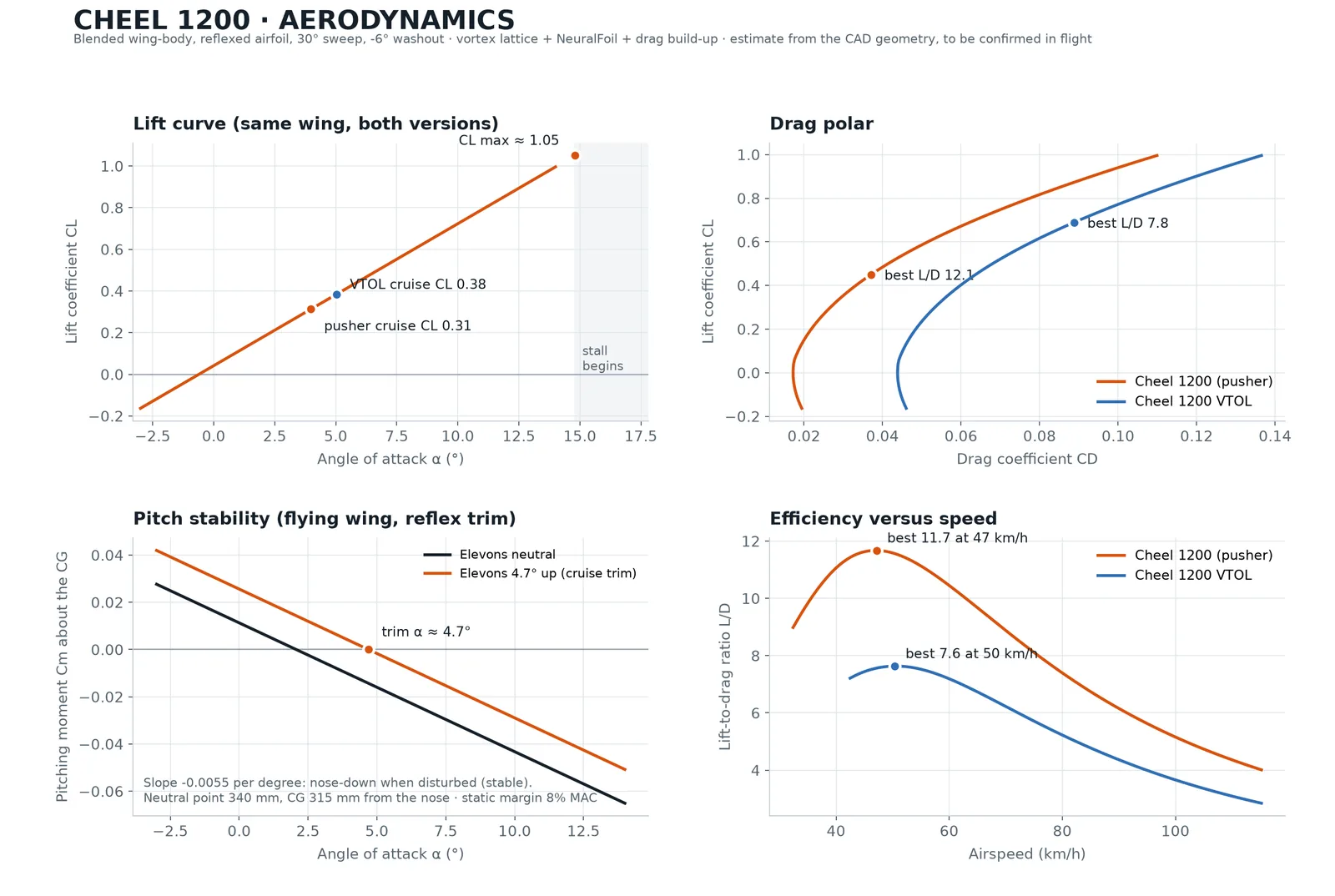
Lift curve, drag polar, pitch stability, L/D versus speed · click to enlarge
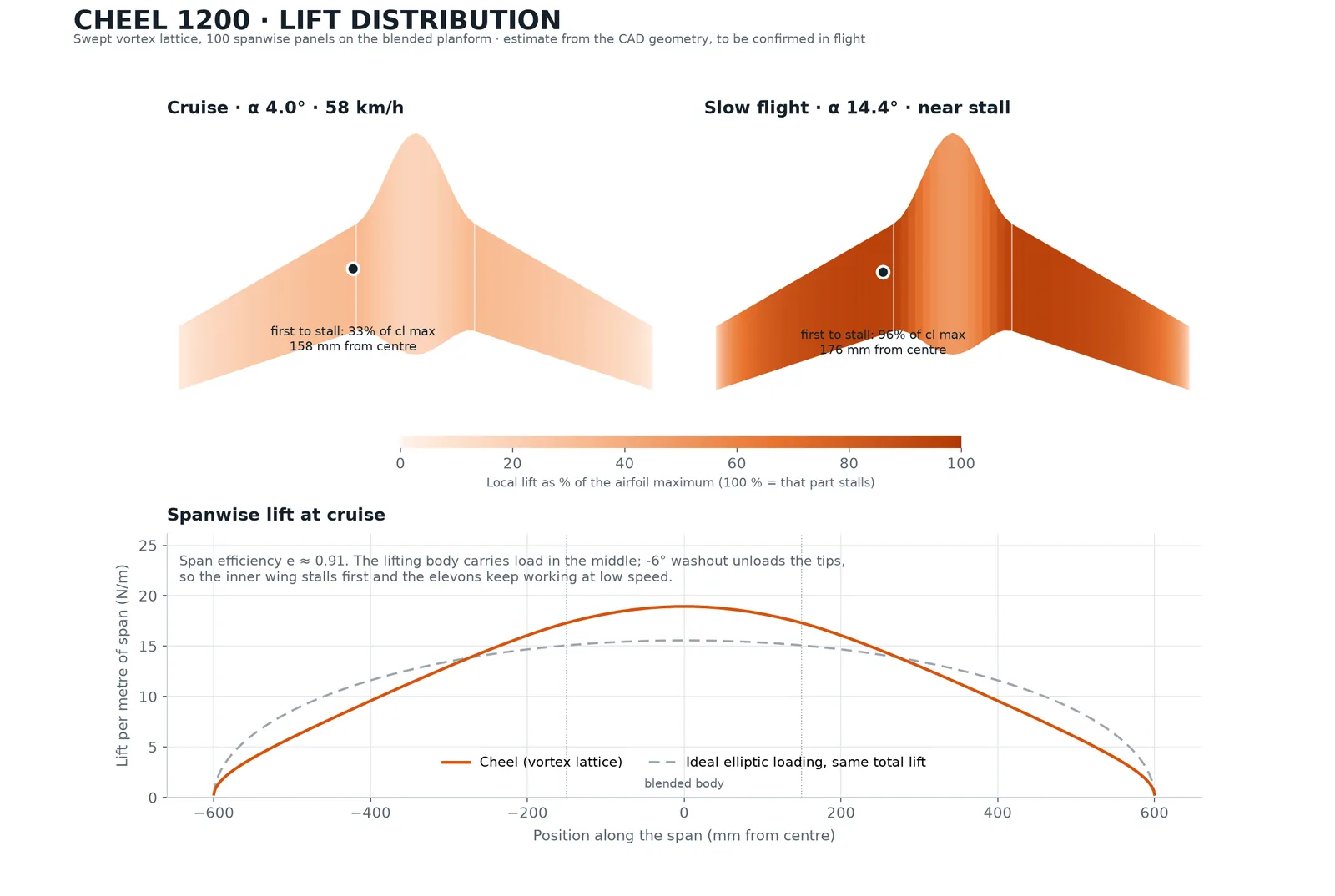
Lift along the span and stall map on the planform · click to enlarge
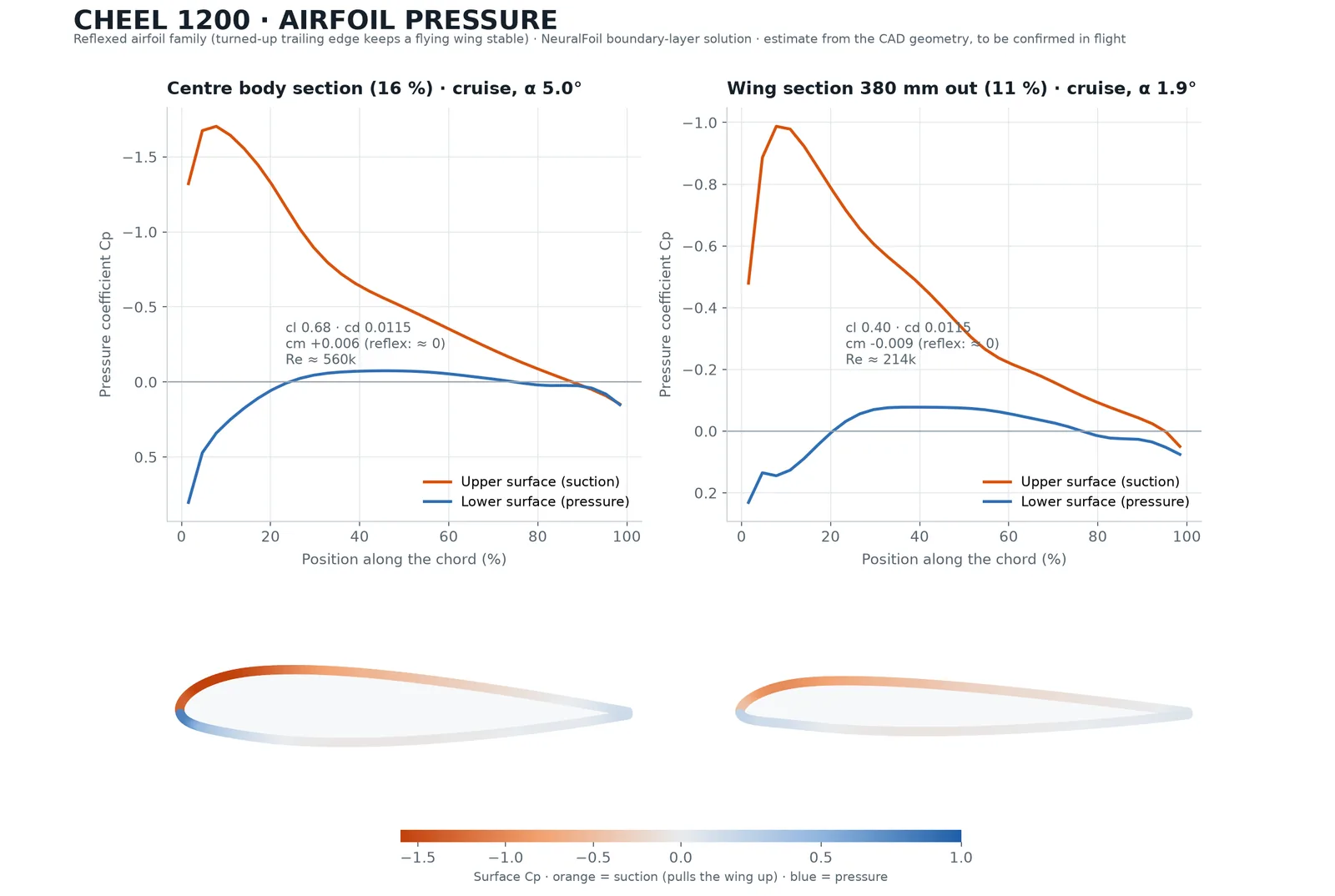
Pressure on the body and wing airfoil sections · click to enlarge
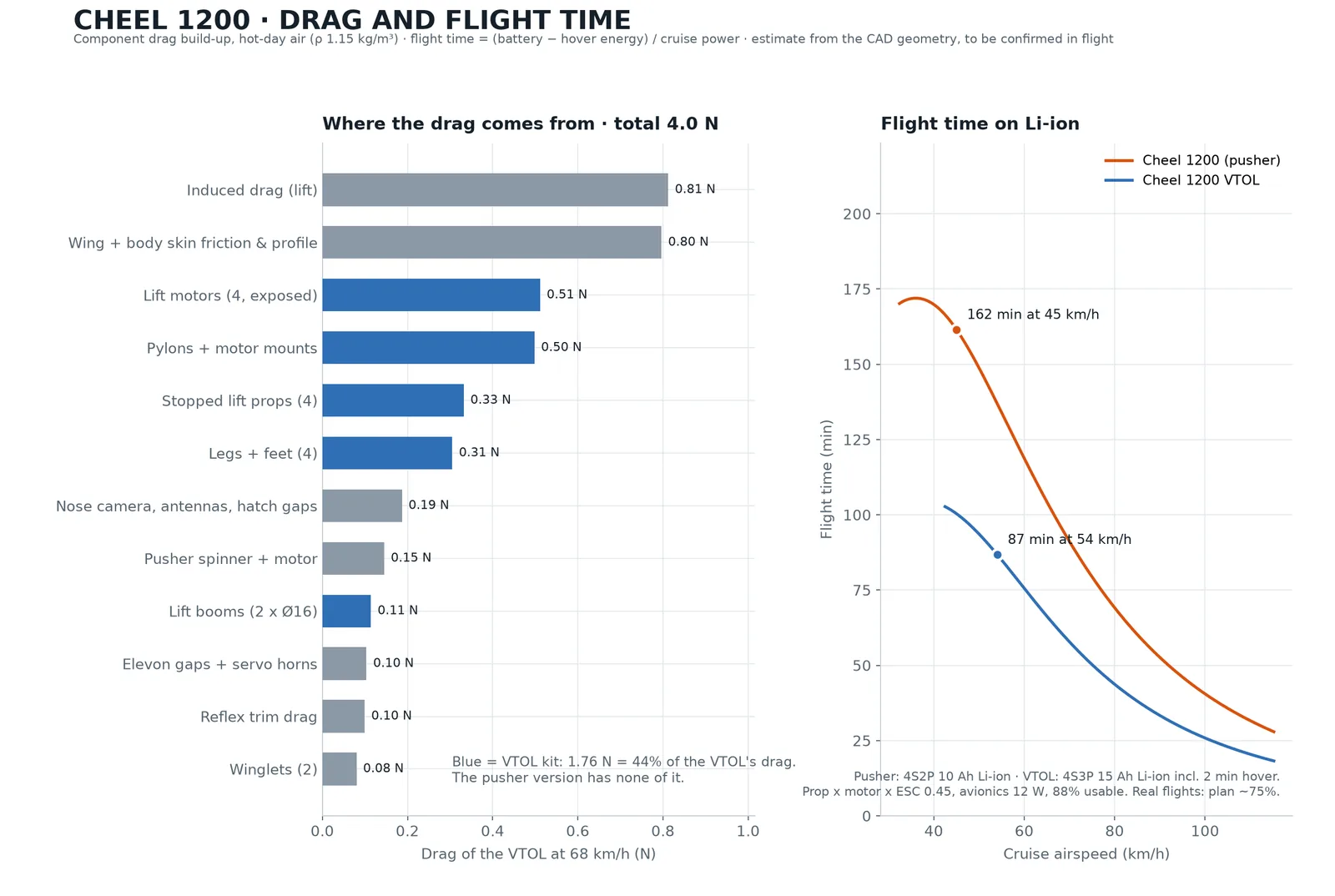
Drag build-up and flight time versus speed · click to enlarge
Stable flying wing
Neutral point 340 mm, CG 315 mm from the nose = 8 % static margin. The reflexed airfoil and −6° washout trim it with about 5° of up-elevon.
Gentle stall
The inner wing stalls first, so the elevons keep working. Span efficiency ≈ 0.91.
Efficiency
Best L/D ≈ 11.7 (pusher) and 7.6 (VTOL).
Flight time
At 58 km/h cruise: ≈ 126 min calculated, plan on ≈ 95 min in real flights.
How it holds together
Swept spars into the body
Each wing's 10 x 8 carbon main spar runs straight into the body; the two spars cross one above the other in a printed spar box, so the load goes carbon to carbon.
Printed webs + ribs
Thin slots inside each wing section print as a shear web along both spars and diagonal (Warren truss) ribs between them: the skin, the ribs and the carbon work as one box.
Plug-in wings
Slide each wing on along its spar, push the 5 mm rear pin home, lock with one M4 nylon bolt from below. Wings off for transport in a minute.
Flat battery under the spars
A single-layer Li-ion pack slides in from the front hatch and sits under the spar crossing; autopilot and ESC live under the rear hatch.
What you get
Sent by email after purchase. Files are for personal use; you may print and fly as many as you like.
- 28 print-ready STL files, pre-oriented for Bambu Lab A1 / P1S / P1P / X1C (256 mm bed)
- Print guide with settings, supports and grams per part
- STEP files of the wing sections, elevons, winglets and VTOL kit + body outer surface
- Whole-plane assembly (.3mf / .glb), pusher and VTOL
- General arrangement drawing, x-ray, wiring and CG guide
- Free updates by email
Both versions: Cheel 1200 + VTOL
One airframe, two planes: fly it as a fast pusher wing, bolt on the VTOL kit when you need vertical take-off.
Instant download link by email · secure card payment by Payoneer
Be first to fly it
Get one email when Cheel 1200 is ready to download, plus the free Chiriya 600. No spam.