Chakor 1300
The small, light member of the LayerWings family. It has a clean pod body with the LayerWings egg nose: a fixed DJI O3 camera set flush in the face, side cooling vents and antenna stubs, plus three top hatches: camera, battery and autopilot. The plug-in side wings slide onto 2 carbon joiners, and a folding pusher sits at the tail. There are no ribs inside: printed shells are glued together and 2 carbon tubes per wing give the strength, the same build as the Koonj 1650. All sizes are in millimetres.
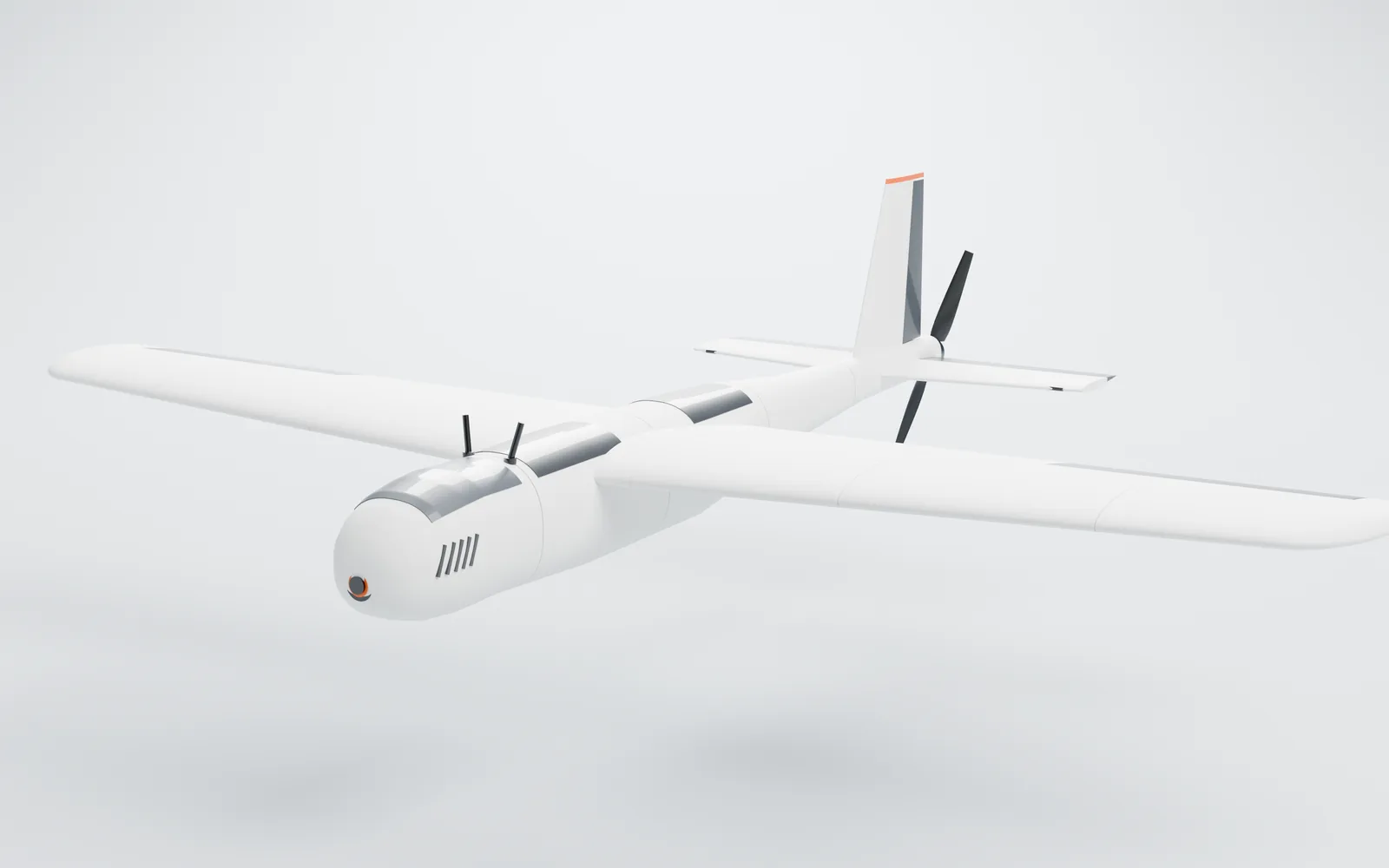
- Wingspan
- 1300 mm
- Length
- 960 mm
- Wing area
- 26.4 dm²
- Flying weight
- ≈ 1140 g
- Printed parts
- 35
- Print time
- ≈ 44 h
Turn it around
Drag to rotate. Open the parts or look inside the skin.
Where everything goes
The camera, battery, autopilot, servos and every carbon tube, shown in place.
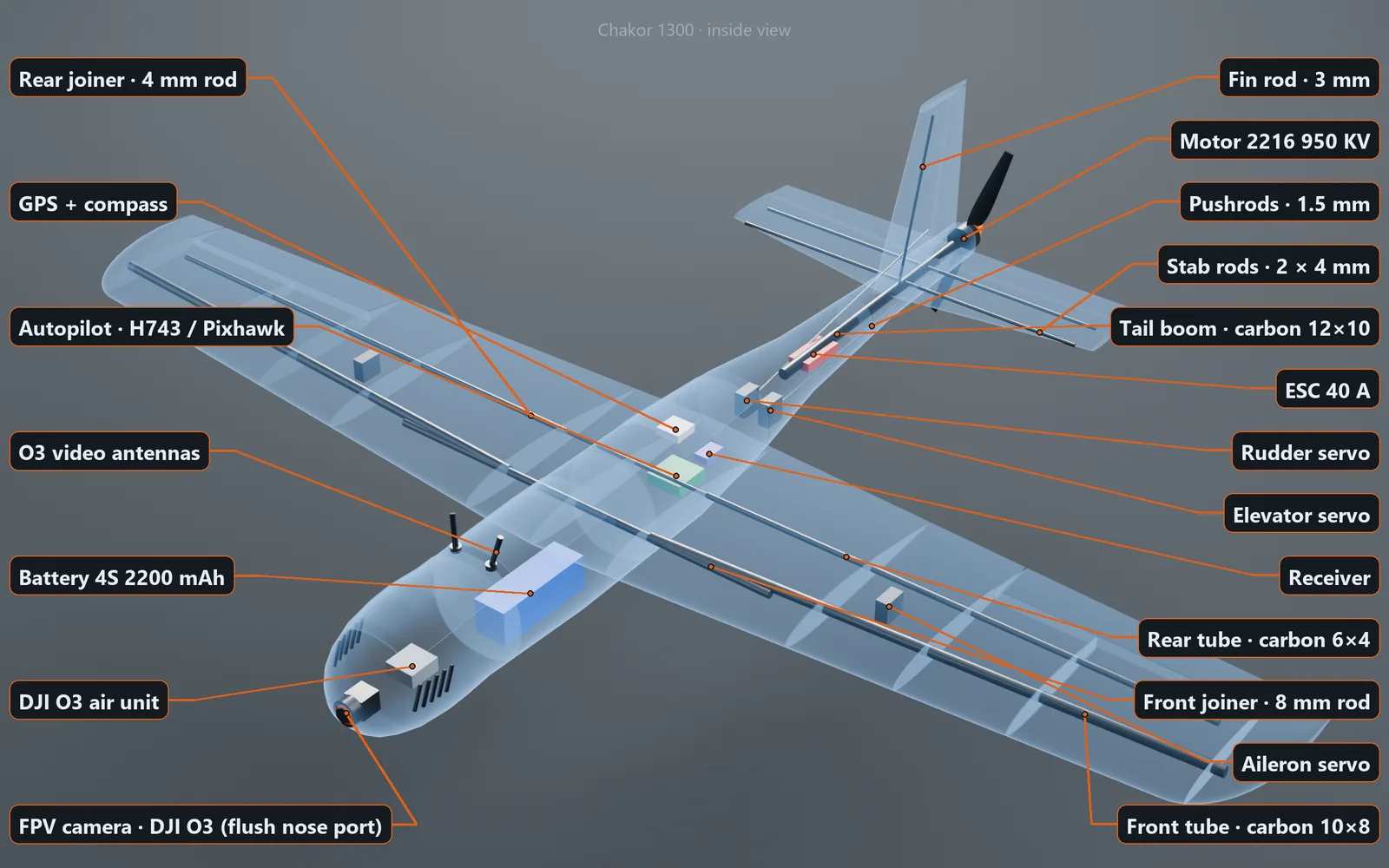
X-ray view · camera, battery, autopilot, servos, tubes and joiners
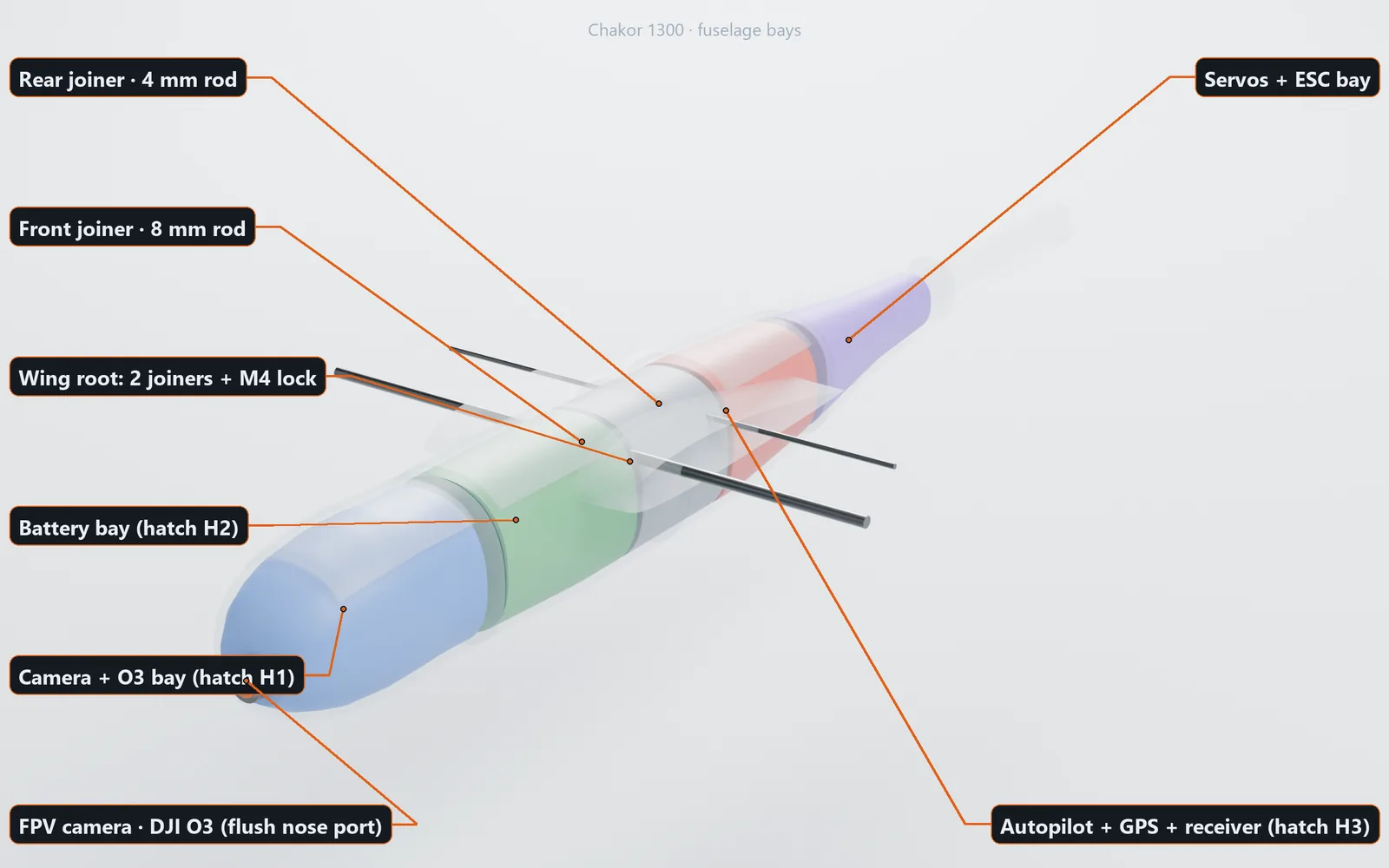
Fuselage bays · camera, battery, wing root, autopilot, servos + ESC
Dimensions and CG
Dashed orange lines show where the parts split for printing. The CG mark is your balance point.
Numbers and setup
| Airframe | Value |
|---|---|
| Wingspan | 1300 mm |
| Overall length | 960 mm |
| Height | 267 mm |
| Root / tip chord | 250 / 160 mm, rounded tips |
| Wing area | 26.4 dm² |
| Aspect ratio | 6.4 |
| Mean chord (MAC) | 208 mm |
| Airfoil | NACA 2412 (12% thick) |
| Wing mount | Side plug-in, shoulder height, 3 sections per side |
| Dihedral | 1.5° each side |
| Stab / fin | 5.0 dm² / 2.0 dm² |
| Tail volume (H / V) | 0.46 / 0.029 |
| Flying weight (est.) | ≈ 1140 g |
| Wing loading | 43 g/dm² |
| Stall speed (est.) | 7.4 m/s (27 km/h) |
| CG | 72 mm behind wing LE at the root |
| CG safe range | 64–78 mm behind LE |
| Max lift coefficient (est.) | 1.29 |
| Best lift/drag (est.) | 14.2 at 40 km/h |
| Static margin (est.) | 18% of mean chord |
| Electronics & setup | Value |
|---|---|
| FPV | DJI O3 air unit, camera fixed forward in the nose |
| Autopilot | Matek H743-WING or Pixhawk 6C mini + M10 GPS |
| Motor | 2216 950 KV outrunner (pusher) |
| Propeller | 9 × 6 in folding pusher |
| ESC | 40 A with 5 V BEC |
| Battery | 4S 2200 mAh LiPo under H2 (or 3S 3000) |
| Servos | 4 × 9 g metal gear (2 wing, 2 tail) |
| Receiver | ELRS or any 4+ channel |
| Launch / landing | Hand launch · belly landing on skid |
| Cruise speed (est.) | 55–70 km/h |
| Flight time (est.) | 15–20 min |
| Throws | Aileron ± 10 mm · elevator ± 8 mm · rudder ± 14 mm |
Connect it once, right
ArduPlane channel map, power path and data links, drawn on the real airframe.
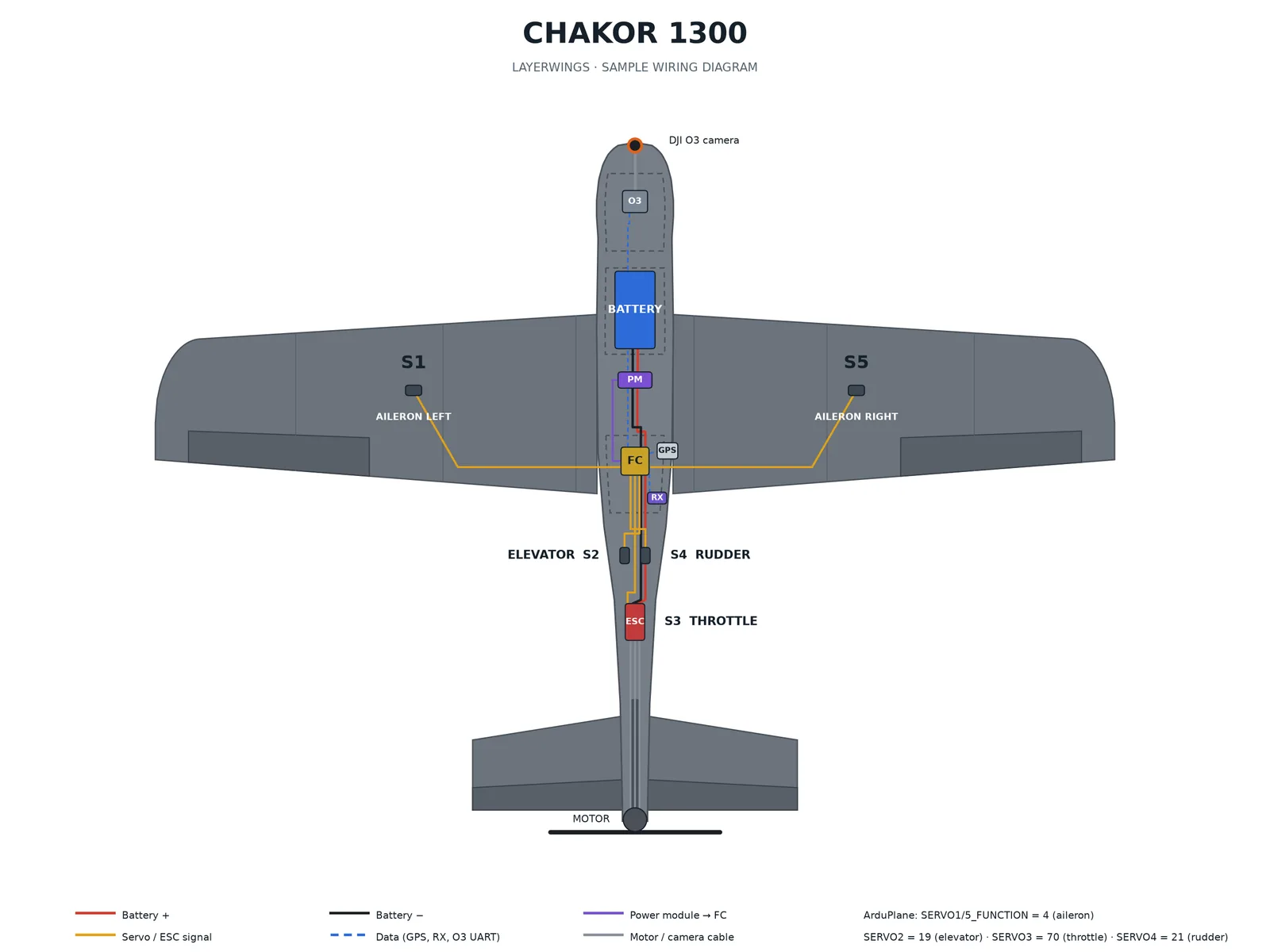
Sample wiring · S1 aileron left, S2 elevator, S3 throttle, S4 rudder, S5 aileron right
How it flies, on paper
Computed for the real geometry: NeuralFoil airfoil data, lifting-line wing, tail and fuselage build-up. An estimate until our flight tests confirm it.
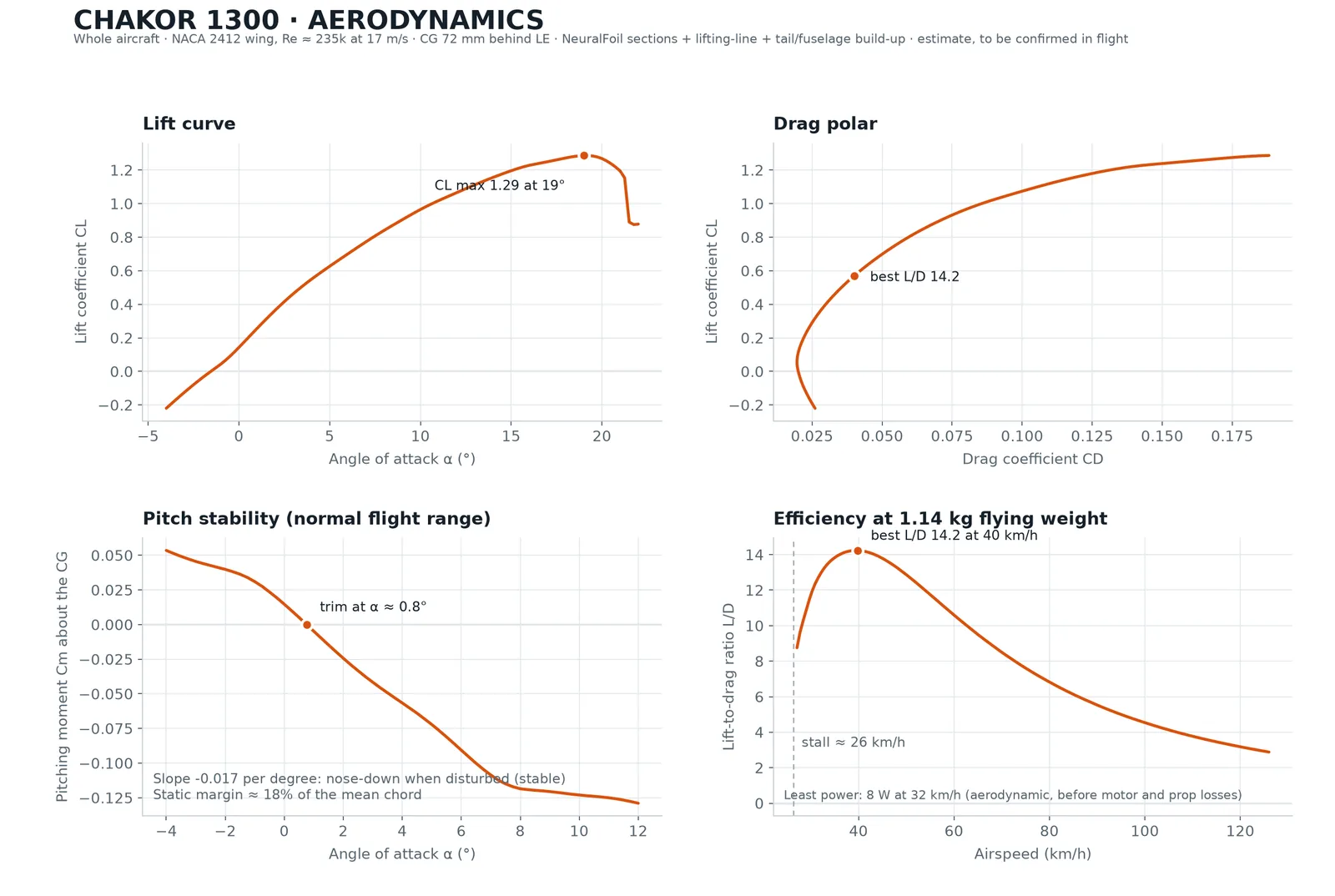
Lift curve · drag polar · pitch stability · lift-to-drag versus airspeed
Parts, filament and carbon
3 wing sections per side and the one-piece ailerons print standing up; wing sections are turned diagonally so the 250 mm root chord still fits a 220 × 220 mm bed (250 mm height). Weights are estimates.
| Code | Part | Qty | Size (mm) | Filament | Each |
|---|---|---|---|---|---|
| Fuselage (printed upright) | |||||
| F1 | Egg nose + flush camera port + side vents | 1 | 160 × 104 × 106 | LW-PLA | 24 g |
| F2 | Battery bay | 1 | 180 × 104 × 112 | LW-PLA | 40 g |
| F3 | Wing root stubs (airfoil) + joiner sleeves | 1 | 180 × 160 × 110 | LW-PLA | 56 g |
| F4 | Rear pod + tail servos | 1 | 200 × 100 × 100 | LW-PLA | 34 g |
| F5 | Tail boom + motor mount seat | 1 | 200 × 46 × 50 | LW-PLA | 20 g |
| H1 | Camera hatch (nose) | 1 | 110 × 80 × 20 | LW-PLA | 4 g |
| H2 | Battery hatch | 1 | 122 × 82 × 18 | LW-PLA | 6 g |
| H3 | Autopilot hatch | 1 | 110 × 80 × 18 | LW-PLA | 5 g |
| Wing (side plug-in halves, printed standing, diagonal) | |||||
| W1 | Root section + root rib (L/R) | 2 | 180 span · 245 chord | LW-PLA | 46 g |
| W2 | Mid section (L/R) | 2 | 200 span · 220 chord | LW-PLA | 40 g |
| W3 | Tip section, rounded (L/R) | 2 | 190 span · 190 chord | LW-PLA | 30 g |
| A1 | Aileron, one piece (L/R) | 2 | 245 × 58 × 10 (standing) | LW-PLA | 9 g |
| Tail | |||||
| S1 | Stabiliser half (L/R) | 2 | 220 × 88 × 11 | LW-PLA | 12 g |
| E1 | Elevator half (L/R) | 2 | 212 × 42 × 8 | LW-PLA | 5 g |
| V1 | Fin | 1 | 170 × 100 × 13 | LW-PLA | 12 g |
| R1 | Rudder | 1 | 166 × 52 × 8 | LW-PLA | 5 g |
| Strong parts | |||||
| M1 | Pusher motor mount | 1 | 60 × 50 × 30 | PLA | 14 g |
| J1 | Joiner sleeve + wing nut plates | 1 | 110 × 70 × 30 | PLA | 14 g |
| C1 | DJI O3 camera bracket (20 mm) | 1 | 34 × 30 × 22 | PLA | 4 g |
| T1 | Autopilot + GPS tray | 1 | 80 × 60 × 40 | PLA | 8 g |
| SV | Servo frames | 4 | 40 × 30 × 15 | PLA | 3 g |
| HN | Control horns | 4 | 25 × 20 × 3 | PLA | 2 g |
| K1 | Belly skid (replaceable) | 1 | 180 × 30 × 10 | PLA | 10 g |
| 35 printed parts | LW-PLA 490 g · PLA 70 g | ||||
| Hardware | Size | Qty | Where |
|---|---|---|---|
| Front wing tube | Carbon tube 10 × 8 mm × 560 mm | 2 | At 25% chord, through all 3 sections of each wing |
| Rear wing tube | Carbon tube 6 × 4 mm × 530 mm | 2 | At 58% chord, through all 3 sections of each wing |
| Front joiner | Carbon rod 8 mm × 400 mm | 1 | Through the body, 150 mm into each front tube |
| Rear joiner | Carbon rod 4 mm × 340 mm | 1 | Through the body, 120 mm into each rear tube |
| Wing lock | M4 × 25 mm nylon bolt + nut plate | 2 | Through each root rib from underneath |
| Tail boom tube | Carbon tube 12 × 10 mm × 300 mm | 1 | Through F4 and F5, keeps the tail stiff |
| Stab rods | Carbon rod 4 mm × 410 mm | 2 | Front + rear, through the boom into both stab halves |
| Fin rod | Carbon rod 3 mm × 190 mm | 1 | From the boom up through the fin |
| Elevator / rudder pushrod | Steel wire 1.5 mm × 320 mm in 3 mm tube | 2 | F4 servos to the tail horns |
| Aileron pushrod | Steel wire 1.5 mm × 70 mm | 2 | Wing servo to aileron horn |
| Hinges | CA hinges 15 × 25 mm | 16 | 4 per aileron, 3 per elevator, 2 rudder |
| Hatch magnets | Neodymium 6 × 3 mm | 12 | 4 per hatch |
| Prop | 9 × 6 in folding pusher + 30 mm hub | 1 | Folds back for belly landings |
| Motor screws | M3 × 8 mm | 4 | Motor to M1 |
| Part | Wall | How it prints |
|---|---|---|
| Wing skin (no ribs inside) | 0.6 mm | LW-PLA shell, 1 perimeter at 0.6 mm line width, 0% infill. The curved shell carries the load |
| Tube channels (front + rear) | 0.8 mm | Printed sleeve from top skin to bottom skin, works as the shear web. 0.2 mm clearance on the tube |
| Root rib (wing side) | 1.2 mm | 3 perimeters, carries the joiners and the M4 bolt |
| Section end faces | 0.6 mm | Thin glue face with alignment keys, no inner ribs |
| Fuselage skin | 0.6 mm | LW-PLA, 1 perimeter |
| Fuselage ring frames | 0.8 mm | At each section joint only |
| Hatches | 0.8 mm | LW-PLA with PLA magnet seats glued in |
| Control surfaces | 0.45 mm | Single wall shell, 2 mm carbon rod in the hinge nose |
| Strong PLA parts | 1.6–2.4 mm | 4–6 perimeters, 30–40% gyroid infill |
How the parts join
Inside the wing
No ribs and no inner grid. Each of the 3 sections is a printed shell with 2 tube channels. Glue the sections together, then slide in the 10 × 8 front tube and the 6 × 4 rear tube.
Wing to body
Two joiners pass through the body: an 8 mm front rod and a 4 mm rear rod. Each wing half slides onto both, so it can't twist, and one M4 nylon bolt locks each root rib.
Hatches
Three magnetic top hatches: H1 nose camera hatch for the DJI O3, H2 battery hatch, H3 autopilot + GPS hatch. Each hatch is held by 4 magnets.
Tail
A 12 × 10 carbon tube stiffens the boom. Each stab half slides onto 2 × 4 mm rods through the boom, and a 3 mm rod runs up the fin. Straight hinge lines keep 30 mm clear of the folding prop.
Be first to fly it
Get one email when Chakor 1300 is ready to download, plus the free Chiriya 600. No spam.